Blog · Comparisons
Gorgias vs Zendesk for Shopify stores: pricing, AI and which one to choose [2026]
For a Shopify store, Gorgias beats Zendesk on Shopify depth and on price for a small team; Zendesk wins for large, multi-department support that goes well beyond the store. We compared both on billing, AI, orders and channels with prices read on October 24, 2026, and if your questions arrive in the storefront chat, there is a third option.
Updated · The Strathly team · 23 min read
On this page
- Gorgias vs Zendesk at a glance
- Shopify depth: built for stores vs connected to them
- Pricing models: tickets vs seats
- The AI agent: what it does and how it's billed
- Channels, workflows and team size
- Setup and the work it takes to run
- Pricing compared
- Which one should you choose?
- Looking for an alternative to both?
- How Strathly helps
- Switching from Gorgias or Zendesk to Strathly
- Frequently asked questions
- Conclusion
Gorgias vs Zendesk is the choice between a helpdesk built for online stores and a customer service suite built for every kind of company. Both answer email, chat and social messages from one inbox, both sell an AI agent, and both connect to Shopify. They differ in what they bill (tickets at Gorgias, agent seats at Zendesk), in how far into a Shopify order your team can go without leaving the ticket, and in how much setup they ask for.
This comparison is written for Shopify merchants: founders, ecommerce managers and support leads deciding where their customers' questions should land. Every price and feature below was read on the vendors' official pricing pages, help centers and Shopify App Store listings on October 24, 2026. If you're already sure you want to leave Gorgias, our guide to Gorgias alternatives for Shopify stores compares seven options; Zendesk has its entry in our Intercom (Fin) alternatives for ecommerce.
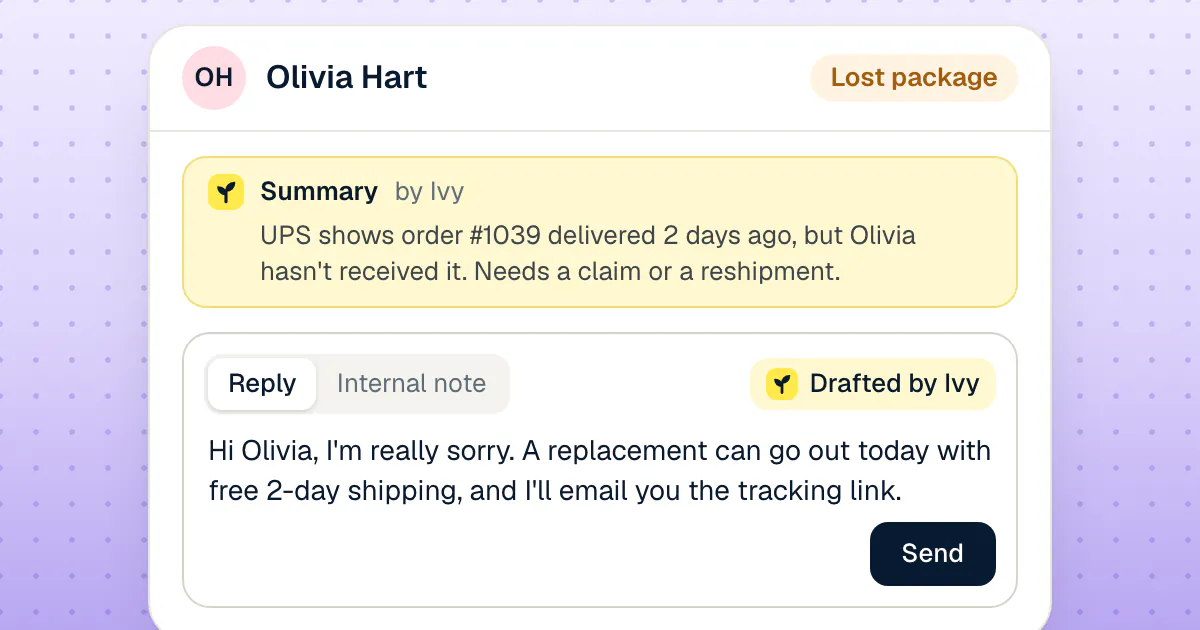
A word on who is writing. Strathly is an AI sales and support agent built only for Shopify stores, not a helpdesk: its assistant, Ivy, answers in your storefront chat, recommends products, finds orders and hands the rest to your team with a drafted reply in a shared inbox. We cover Gorgias and Zendesk fairly first, then show where Strathly fits. If your questions mostly arrive in the chat, you can see the difference on your own catalog: Install on Shopify. Setup takes about 2 minutes. 14-day free trial. Cancel anytime.
Gorgias vs Zendesk at a glance
| Strathly | Gorgias | Zendesk | |
|---|---|---|---|
| Built for | Shopify stores only | Ecommerce stores (Shopify first) | Every industry |
| Where customers write | Storefront chat | Email, chat, SMS, voice, social | Email, messaging, voice, social, help center |
| Priced by | Ivy conversations | Tickets a month | Agent seats |
| Team seats included | Yes | Yes | No |
| AI billed per answer it resolves | No | Yes | Yes |
| AI recommends products with Add to cart | Yes | Partial | Not listed |
| Team refunds, cancels and changes the address of Shopify orders in the conversation | Yes | Yes | Partial |
| AI acts on Shopify orders by itself | Yes | Yes | Not listed |
| Public help center | No | Yes | Yes |
| Phone support | No | Yes | Yes |
| iPhone app for the team | Yes | Yes | Yes |
| Android app | No | Yes | Yes |
| Free trial | 14 days | 7 days | 14 days |
Read on October 24, 2026 on Gorgias's and Zendesk's pricing pages, help centers and Shopify App Store listings; Strathly from its product. "Partial" means the feature exists with limits explained below: Gorgias's AI Agent has a shopping assistant role, but we found no add-to-cart in the chat documented; Zendesk's Shopify integration lets agents view orders and refund or cancel them, with address changes and order edits left to flows you build. Strathly's assistant answers from your policies, pages and files rather than a public help center, and its iPhone app is free on the App Store. "Not listed" means we found nothing on the vendor's official pages, not that it can't be built.
The rest of this article explains the rows that change your month: what each tool bills, what its AI does, how deep each goes into Shopify, and how much work each takes to run.
Shopify depth: built for stores vs connected to them
Gorgias is the more Shopify-native of the two, and it shows the moment a ticket opens. Gorgias puts the customer's Shopify orders next to every conversation, and its help center documents what agents can do there without opening Shopify: create, duplicate, cancel, refund and edit orders, make draft orders, edit the shipping address and send product links. It was built for ecommerce, it lists Shopify first among its platforms, and its app holds 4.3 stars from 706 reviews on the Shopify App Store.
Zendesk reaches Shopify through an integration. Its help center describes a sidebar that shows a customer's Shopify orders in the ticket, matched by email or phone, where agents can refund an order (in full or in part) and cancel one that hasn't shipped. Anything beyond that, such as editing an order, is a flow you build with Zendesk's integration tools; we found no official Zendesk page showing its AI agents acting on Shopify orders by themselves. The Shopify App Store listing holds 3.2 stars from 95 reviews, 31% of them one-star, and its newest written review, dated September 30, 2026, describes the sidebar app failing to connect.
For a store, that difference is daily, not theoretical. A support person at a Shopify brand spends most of the day on "where is my order", "can I change my address" and "it arrived damaged". In Gorgias those are a sidebar and two clicks. In Zendesk a refund or a cancellation is a click too, and an address change or an edited order is a flow you build first.
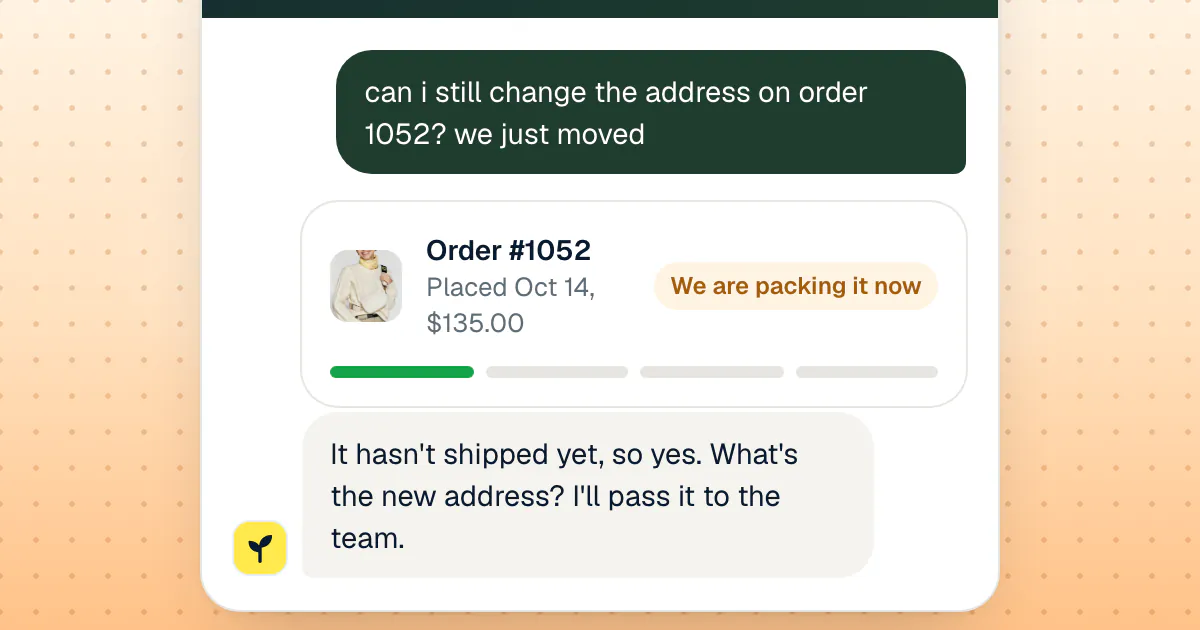
Strathly takes the same Shopify depth one step earlier, into the chat itself. With the order number and the email used at checkout, Ivy finds the order in Shopify, shows its status and tracking, and, when the shopper wants something you have to approve, hands the conversation to your team with the reason and the facts already gathered.
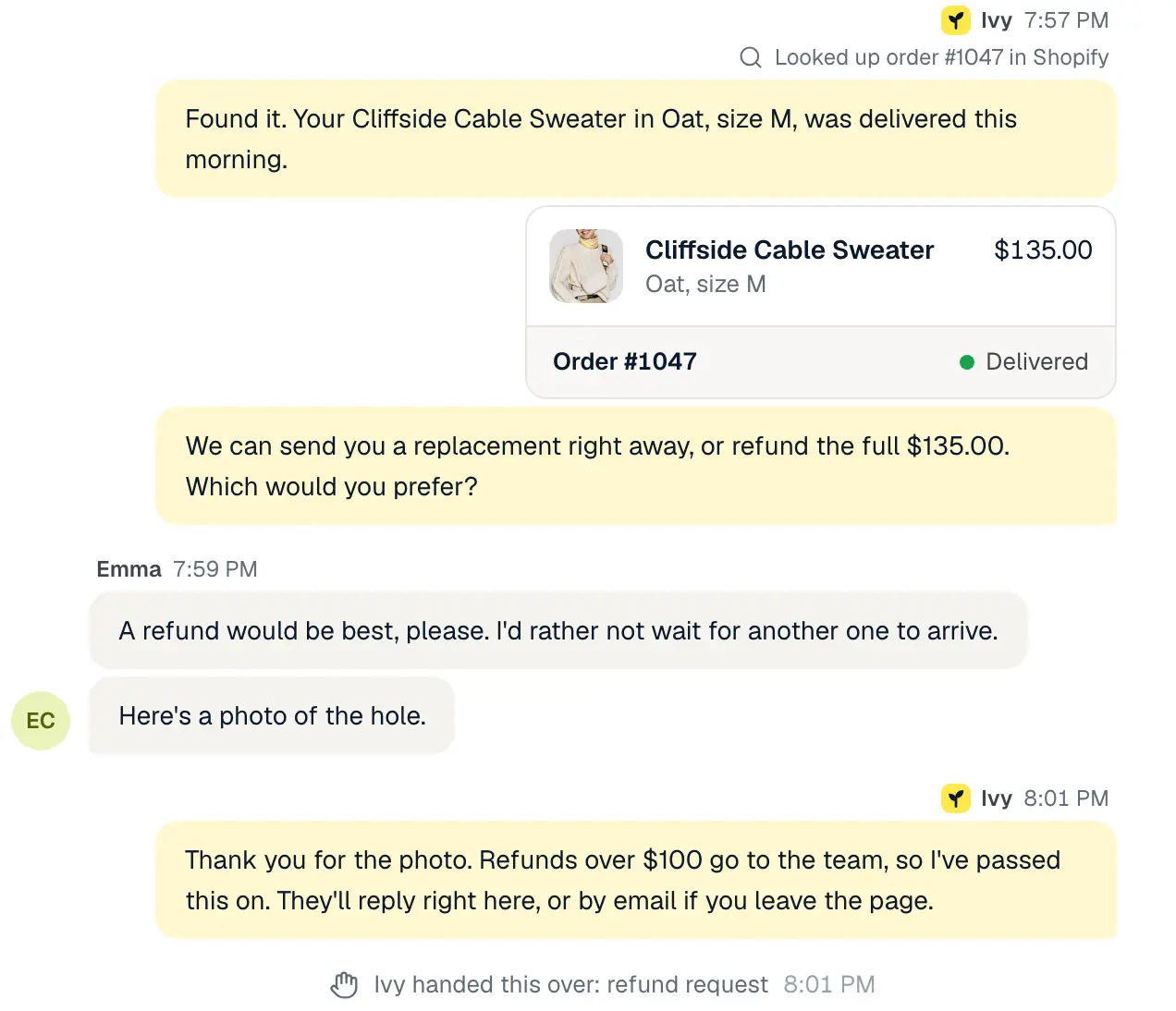
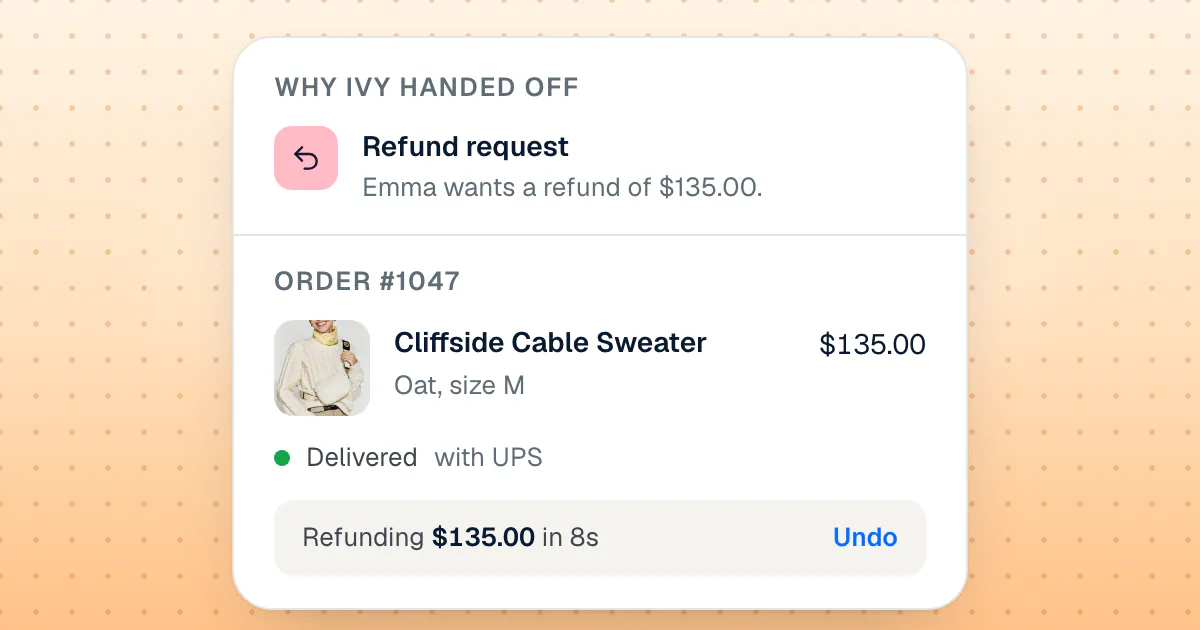
The refunds, cancellations, address changes and replacements a teammate then sends from the Inbox go straight to Shopify with 10 seconds to undo, and you decide which of them Ivy may do herself. The docs explain which order actions Ivy can take and how you switch them on.
Pricing models: tickets vs seats
Gorgias charges by the number of tickets your store handles each month; Zendesk charges for each agent who logs in. That one difference decides which is cheaper for you, more than any headline price.
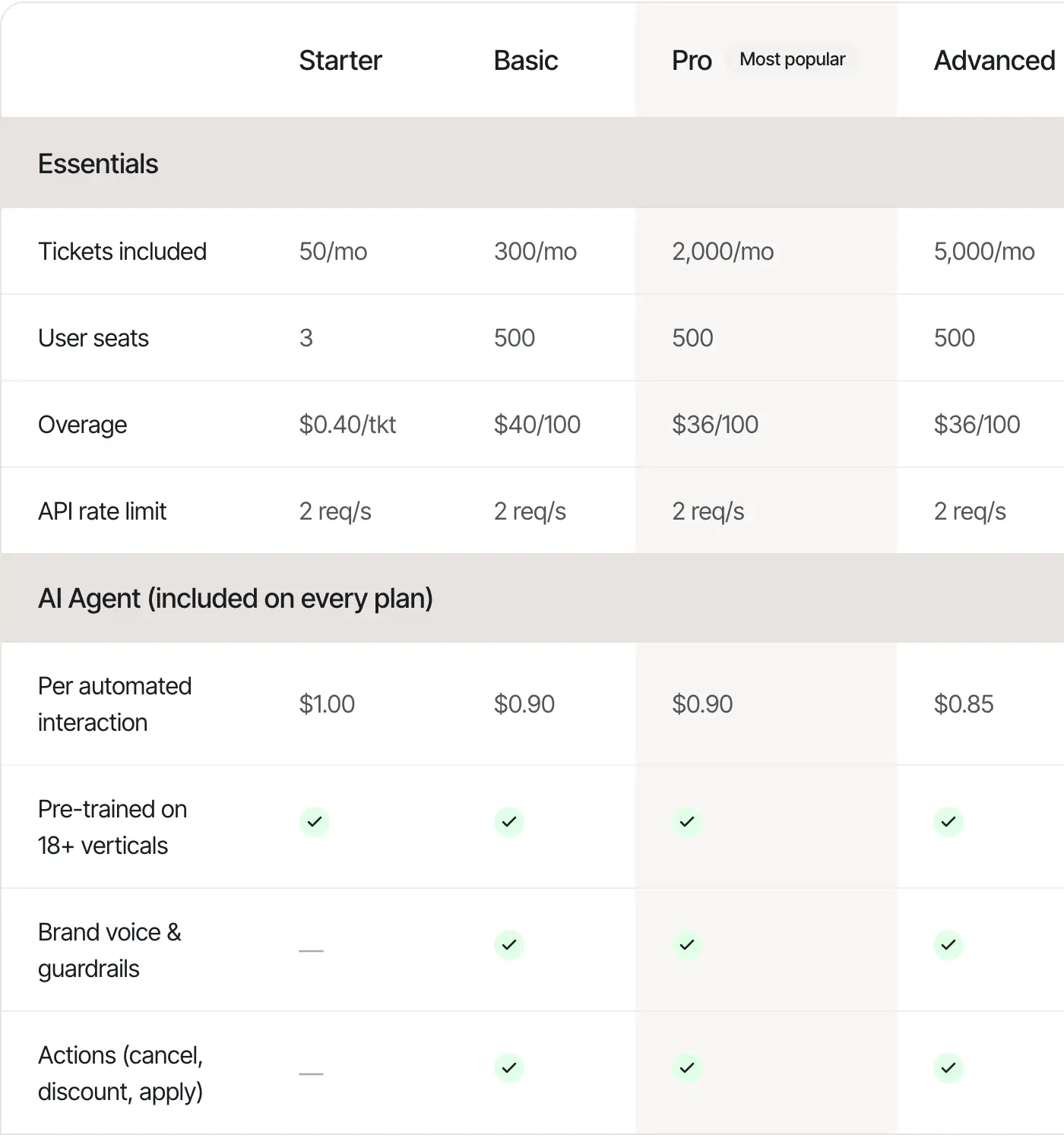
Gorgias: tickets, not people. Every Gorgias plan includes a number of billable tickets a month, and the pricing page says the helpdesk is "never priced per agent": its comparison table gives Starter 3 user seats and every other plan 500. A billable ticket is a conversation that gets a message from an agent, a rule or the AI Agent. A store with a big team and few tickets pays little; a store with a small team and many tickets pays for every extra one, $0.40 a ticket on Starter and Basic and $0.36 on Pro and Advanced.
Zendesk: people, not tickets. Zendesk's plans are priced per agent a month, with no ticket count. A team of two pays for two seats however many tickets arrive; a team of ten pays for ten even in a quiet month. That suits steady, high-volume support with a stable team; it hurts a store that needs seasonal helpers for Black Friday.
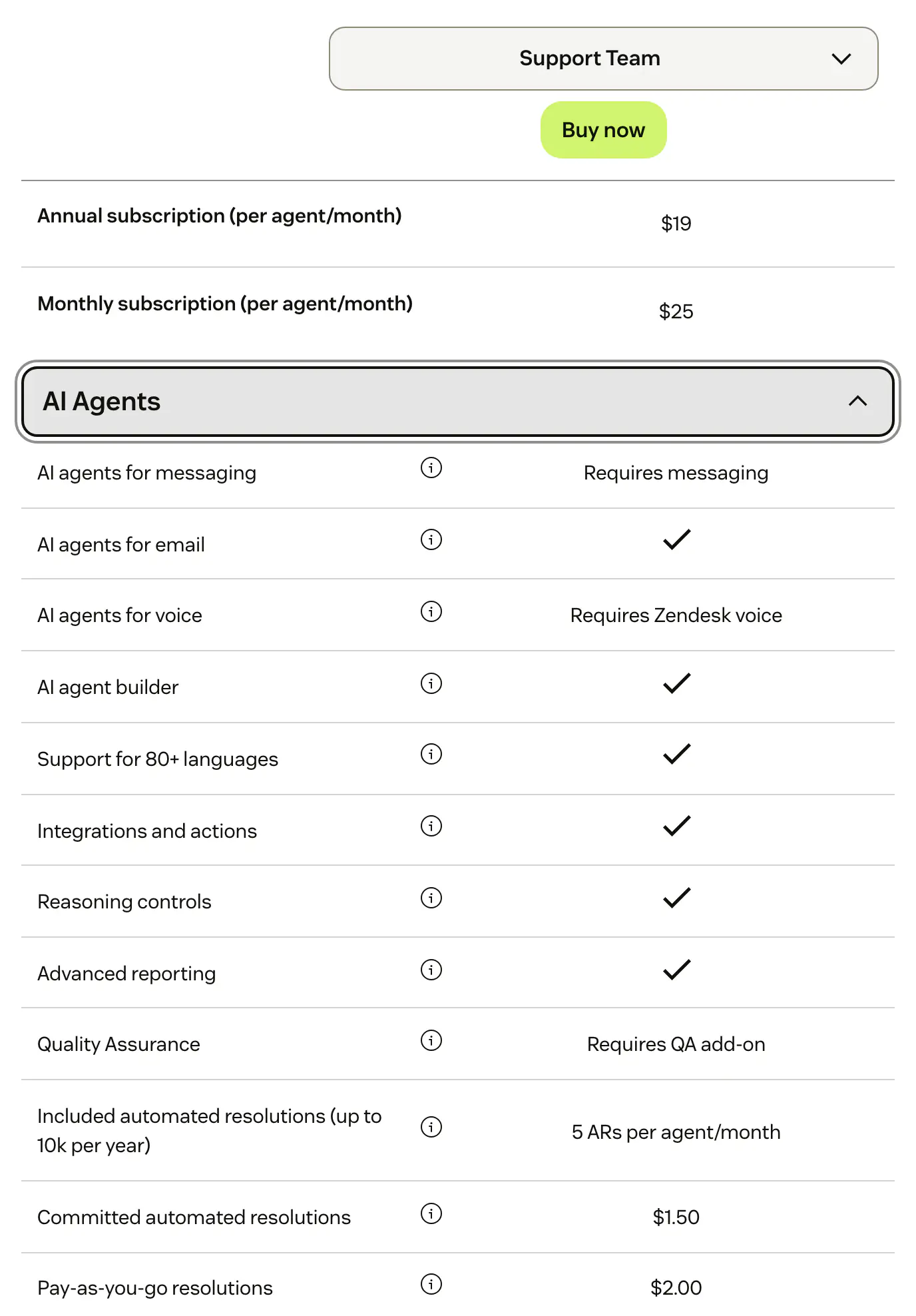
The AI is a third line at both. Gorgias bills its AI Agent per automated interaction, and its pricing FAQ adds that each one "also counts as a helpdesk ticket and is billed accordingly". Zendesk includes 5 or 10 automated resolutions per agent a month, depending on the plan, and bills each one after that. Both meters rise with every question the AI handles well, which is exactly the volume you hoped the AI would take off your hands.
Strathly has one unit: the conversation Ivy takes. A conversation she resolves and one she hands to your team cost the same, everything one shopper asks within 24 hours is one conversation, and your teammates' replies never count. The full rule is on what counts as a conversation.
The AI agent: what it does and how it's billed
Both tools now sell an AI agent that answers customers on its own. They differ in what it is built to do and in how they count what it does.
Gorgias AI Agent works in two roles in one subscription: a support agent for questions after the purchase and a shopping assistant that helps customers "find products and make a purchase". It works on email, chat, SMS and social messages, supports more than 80 languages according to Gorgias's help center, and hands over to an agent when it should. With Actions switched on (from the Basic plan), it can cancel an unfulfilled order with a refund, edit the shipping address, remove or replace an item and reship an order for free. It is billed per "automated interaction", a customer request fully resolved without a human agent, at $0.85 to $1.00 depending on the plan and billing, and $1.50 above the plan's allowance. If an agent replies within 72 hours of an AI resolution, the interaction is charged only as a ticket.
Zendesk AI agents are general-purpose: they answer from your knowledge base, run flows you build in the AI agent builder, and connect to other systems through "integrations and actions" you configure. They work on email, messaging and voice (messaging and voice need those Zendesk products) and support more than 80 languages. Since May 18, 2026, only "verified resolutions" count against your allowance: the customer didn't ask for more help within the window (72 hours for email, 2 hours by default for messaging) and an AI check of the conversation confirms the request was resolved. A conversation the AI helped with but a person finished doesn't count.
The practical difference for a store: Gorgias's AI starts with commerce built in, Zendesk's starts as a toolkit. A merchant gets more out of Gorgias on day one; a large team with someone to build and maintain AI flows gets more control out of Zendesk.
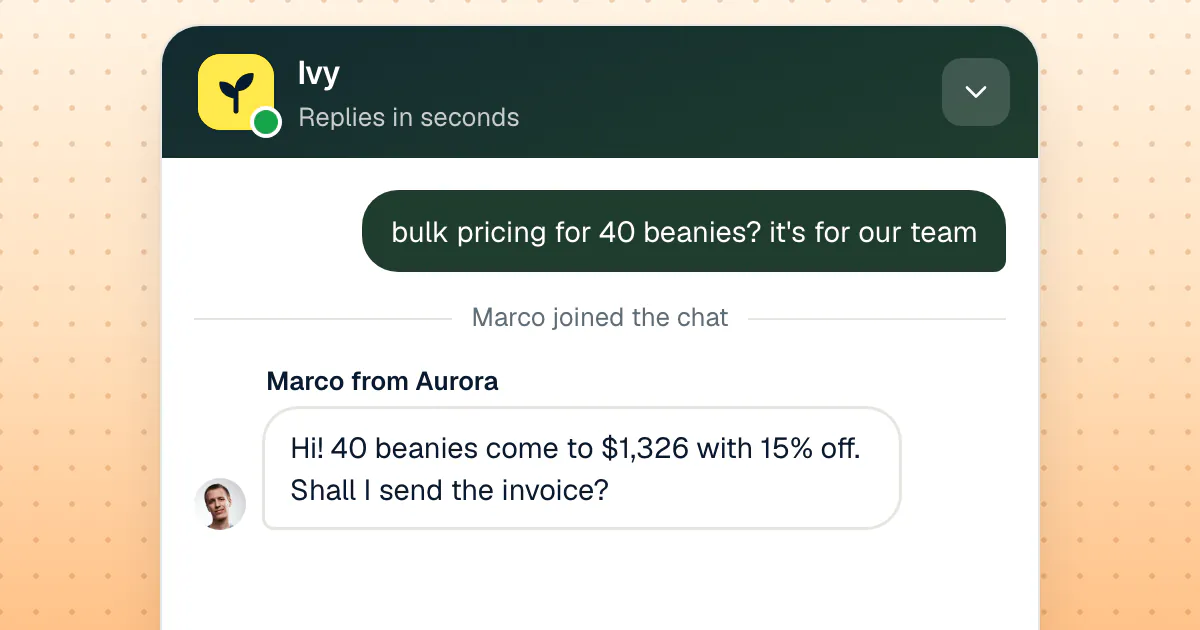
Neither one puts selling at the center of the chat. A question like the one below, asked on a product page the week before a holiday, is a sale waiting to happen, and in a ticket queue it waits.
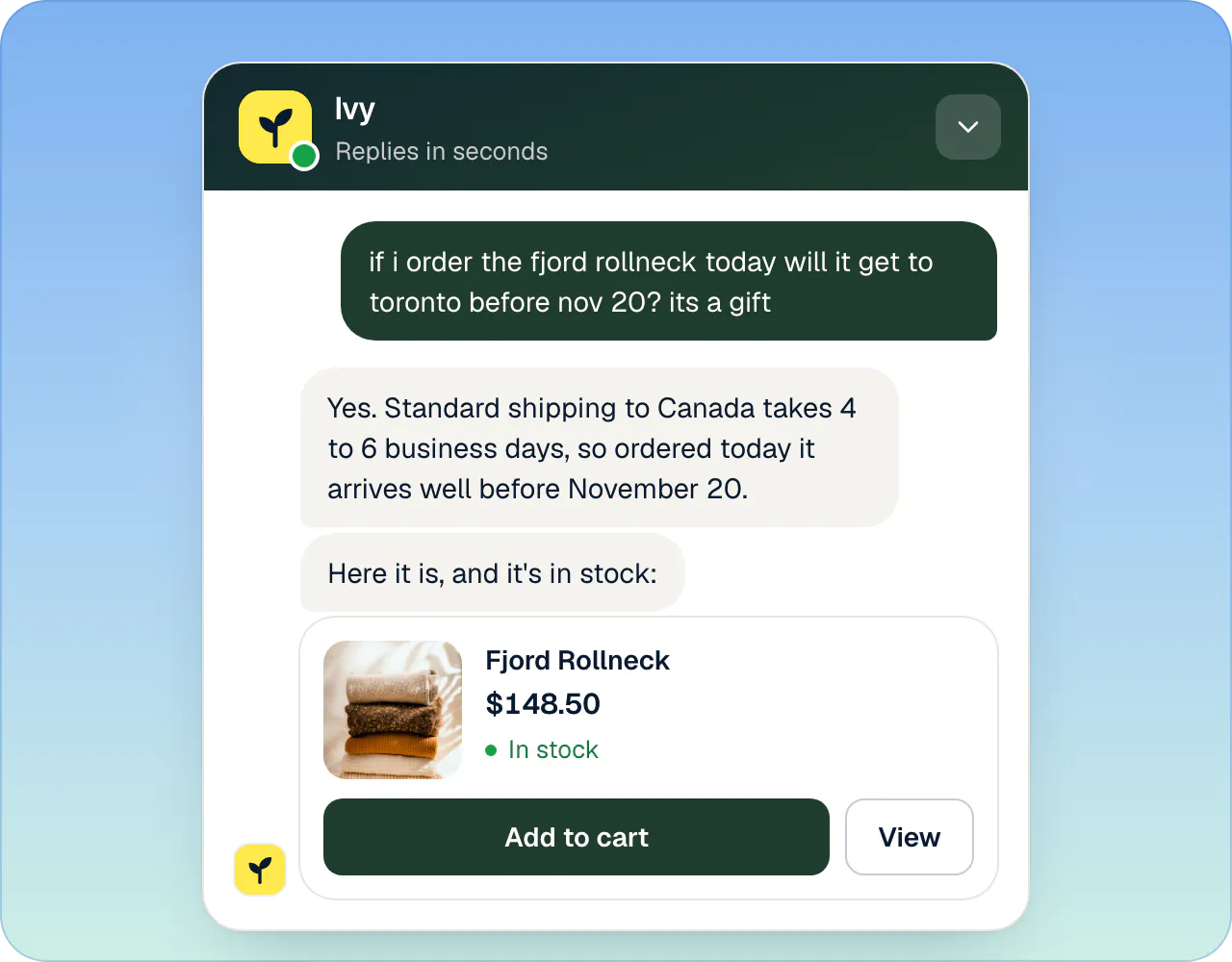
Ivy answers that kind of question from your Shopify shipping rates and catalog, and puts the product in the chat with Add to cart. That is an AI shopping assistant that recommends from your live catalog, and it is included on every Strathly plan.
Channels, workflows and team size
Zendesk is the bigger platform, and for some companies that is the point. Suite Team combines email and ticketing, messaging and live chat, telephony, omnichannel routing, a knowledge base, AI agents and an action builder; Suite Professional adds skills-based routing, an IVR phone tree and AI writing tools; add-ons bring Copilot, workforce engagement and quality assurance. It is built for companies with many departments, several brands and large support teams.
Gorgias covers the channels a store needs, email, chat, social messages and a help center on every plan, with voice and SMS as add-ons priced by volume, and adds the workflows a support team needs: rules, macros and views, plus revenue analytics on its Pro plan. It is built for the support teams of ecommerce brands, from a founder answering alone to a team of dozens.
Both have iOS and Android apps for agents.
For a store, the question is how many of those channels your customers actually use. Many Shopify brands get most of their questions in the storefront chat and a long tail by email. If that is your store, a full helpdesk is a lot of structure for "does this run small?". What you need on the team side is a clear rule for what reaches a person, and a way to answer fast.
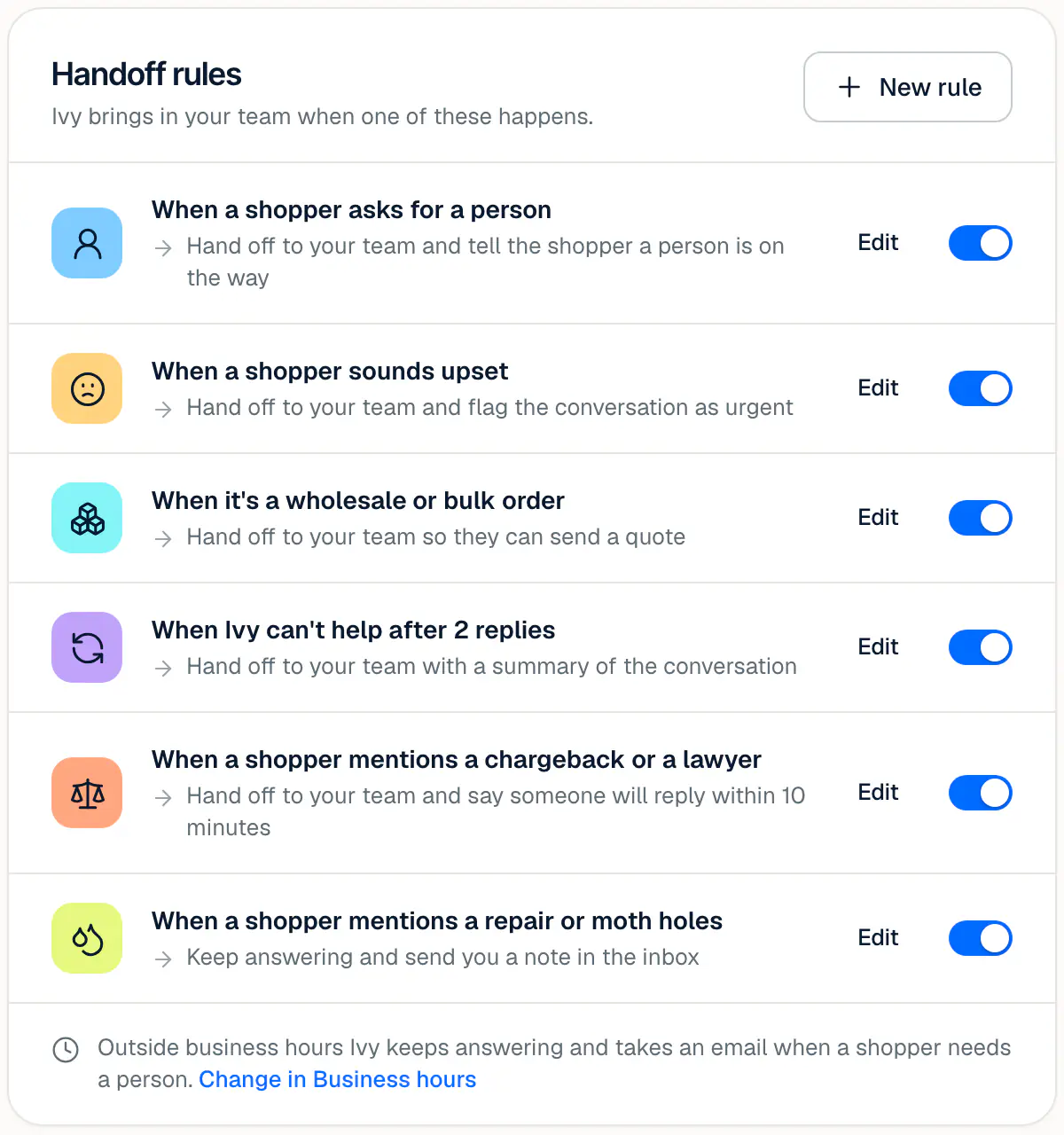
In Strathly those are handoff rules: switches for a shopper who asks for a person, sounds upset or wants a wholesale quote, plus keyword rules you write yourself, each with an action and a line for the shopper. The docs show how to write a keyword rule.
Setup and the work it takes to run
Gorgias asks less of you than Zendesk to get started on Shopify. You install the app, connect your store and email, add the chat to your theme, write or import macros, and turn on the AI Agent with its guidance and Actions. Gorgias offers a 7-day trial without a card. The ongoing work is tuning: rules, macros and what the AI Agent may do.
Zendesk is a bigger project. You choose a plan, configure channels, groups, routing and automations, connect the Shopify integration, write or migrate knowledge base articles for the AI agents to read, and build the flows for order questions. Zendesk offers a 14-day trial of Suite Professional without a card. For a small store, the time all that takes is the hidden cost.
Strathly's setup is the shortest of the three because it does less: there is no email inbox, no ticket schema and no help center to build. You connect Shopify, Ivy reads your products, policies, pages and shipping rates, you test her in the Playground on your real data, and you switch on the chat as a Shopify theme app embed with no code. How Strathly goes from install to first answer shows each step; the site describes it as about two minutes.
Pricing compared
Here are both vendors' published prices as read on October 24, 2026, then what a small and a mid-size team would pay. All prices are in US dollars, before tax.
Gorgias pricing
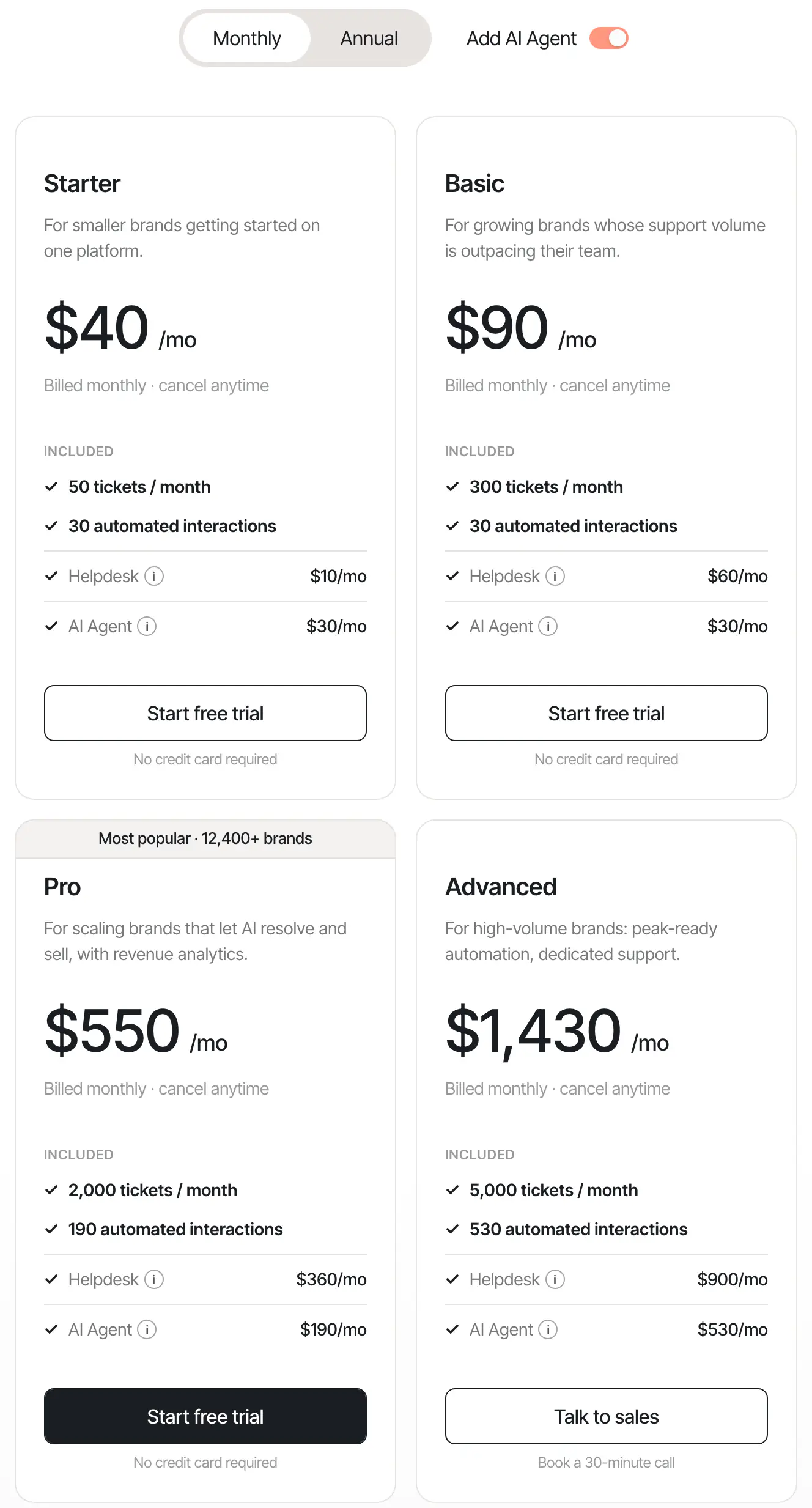
- Helpdesk plans, monthly: Starter $10 (50 tickets, monthly only), Basic $60 (300 tickets), Pro $360 (2,000 tickets), Advanced $900 (5,000 tickets); on annual billing Basic is $50, Pro $300 and Advanced $750 a month. Enterprise: contact sales.
- With the AI Agent added, monthly: Starter $40 and Basic $90 (each with 30 automated interactions), Pro $550 (190), Advanced $1,430 (530).
- With the AI Agent added, annual (per month): Basic $77, Pro $471, Advanced $1,227.
- AI Agent: $1.00 per automated interaction on Starter, $0.90 on Basic and Pro, $0.85 on Advanced (comparison table); $1.50 for each interaction above the plan's allowance. Each AI interaction also counts as a helpdesk ticket. AI order Actions and brand voice start on Basic.
- Ticket overage: $0.40 a ticket on Starter and Basic, $0.36 on Pro and Advanced.
- User seats: 3 on Starter, 500 on Basic, Pro and Advanced.
- Voice and SMS: add-ons priced by volume.
- Free trial: 7 days, no card.
Source: Gorgias's official pricing page and its Shopify App Store listing, read October 24, 2026.
Zendesk pricing
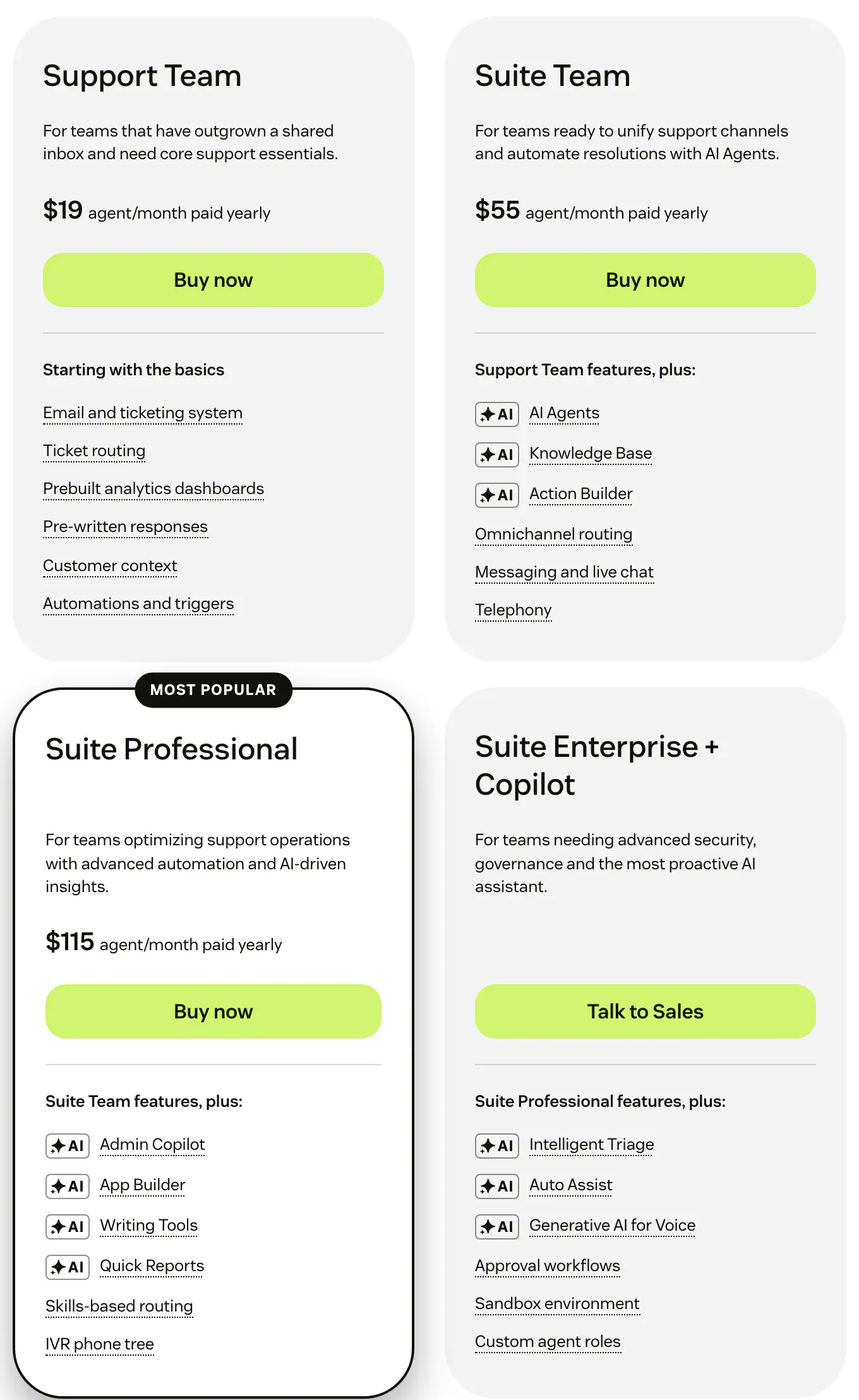
- Per agent a month, billed annually / monthly: Support Team $19 / $25 (email and ticketing, no messaging or live chat), Suite Team $55 / $69, Suite Professional $115 / $149. Suite Enterprise + Copilot: talk to sales. The Shopify App Store listing also shows Suite Growth at $89 and Suite Enterprise at $150, billed annually.
- AI agents: 5 automated resolutions per agent a month included on Support Team and Suite Team, 10 on Suite Professional; additional resolutions $1.50 each committed or $2.00 pay-as-you-go. Only verified resolutions count.
- Add-ons, per agent a month billed annually: Copilot $50, Workforce Engagement $50, Contact Center $83.
- Free trial: 14 days on Suite Professional, no card.
Source: Zendesk's official pricing page, its help center article on automated resolution billing, and its Shopify App Store listing, read October 24, 2026.
Strathly pricing
| Plan | Price a month | Ivy conversations a month | Extra conversation | Teammates |
|---|---|---|---|---|
| Starter | $39 | 100 | $0.39 | 2 |
| Growth | $79 | 300 | $0.26 | 5 |
| Scale | $199 | 1,000 | $0.20 | Unlimited |
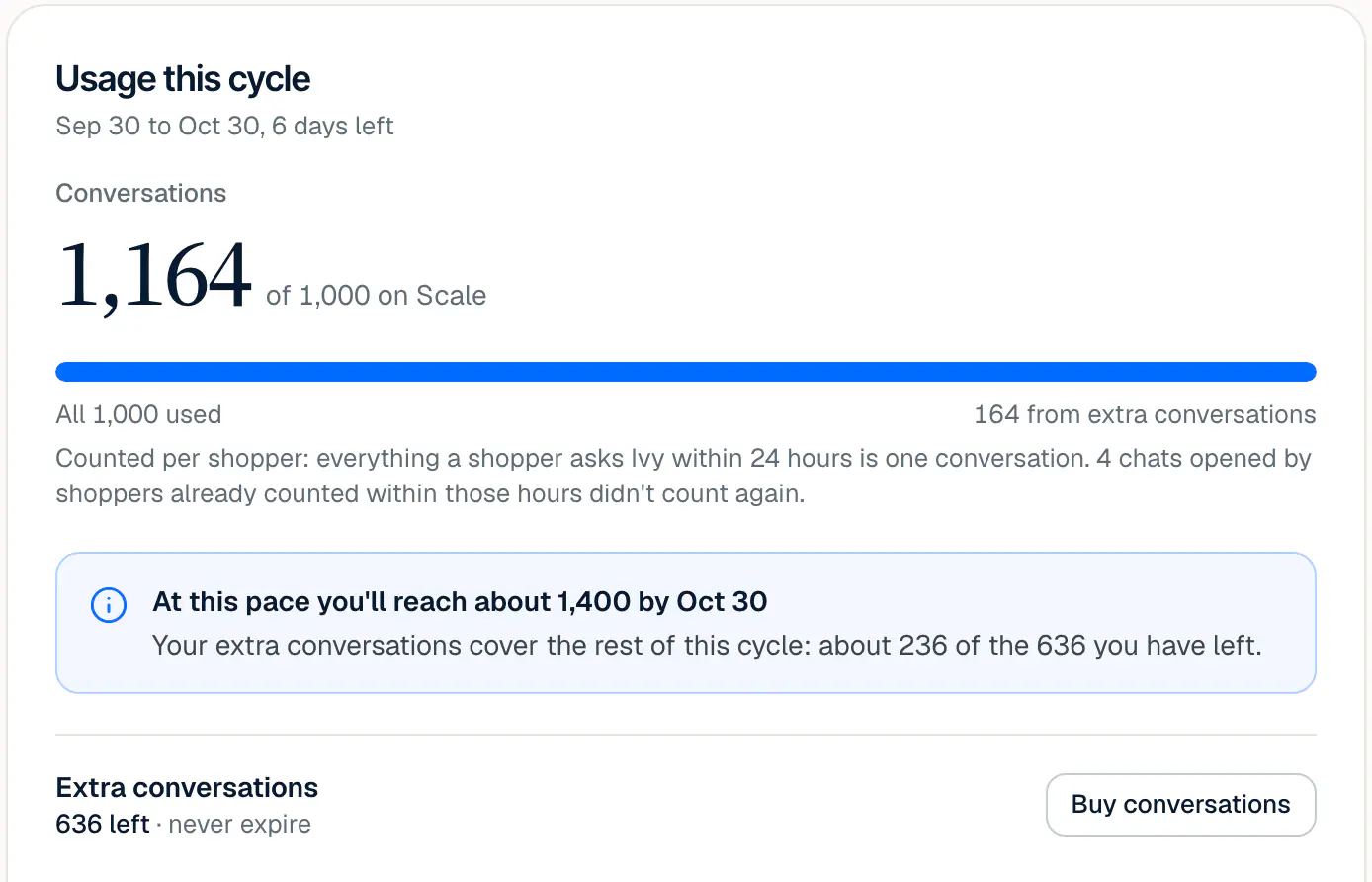
Prices in US dollars, excluding VAT and sales tax. Plans are billed monthly through Shopify, every feature is on every plan, and extra conversations are bought ahead from 10 at a time at your plan's rate and never expire. There is no automatic overage: when the conversations run out, Ivy finishes the ones she is in and new shoppers reach your team. Strathly's plans and prices has the calculator.
What a month costs: two worked examples
Assumptions, stated so you can redo the math with your own numbers: every customer question is one conversation; the AI fully resolves half of them and a person answers the other half; prices are the monthly ones above, read October 24, 2026. For Strathly we assume the questions arrive in the storefront chat, where Ivy takes each one first and hands half to the team.
A store with 2 people and 300 conversations a month (the AI resolves 150):
- Gorgias: Basic with the AI Agent, $90, covers 300 tickets and 30 automated interactions. The other 120 AI interactions cost $1.50 each, $180. About $270 a month.
- Zendesk: 2 Suite Team seats (the first plan with live chat) at $69 each on monthly billing, $138, with 10 automated resolutions included. The other 140 at $2.00 pay-as-you-go cost $280. About $418 a month (about $320 on annual billing with committed resolutions).
- Strathly: 300 Ivy conversations and 2 teammates fit in Growth: $79 a month, the team's replies included.
A store with 5 people and 1,000 conversations a month (the AI resolves 500):
- Gorgias: Pro with the AI Agent, $550, covers 2,000 tickets and 190 automated interactions. The other 310 cost $1.50 each, $465. About $1,015 a month.
- Zendesk: 5 Suite Team seats at $69, $345, with 25 automated resolutions included. The other 475 at $2.00 cost $950. About $1,295 a month (about $988 on annual billing with committed resolutions).
- Strathly: 1,000 Ivy conversations with 5 teammates fit in Scale: $199 a month, with teammates unlimited.
Two honest caveats. Gorgias and Zendesk also answer your email, social and phone tickets in these prices, which Strathly does not; and both offer lower rates on annual contracts and committed volumes. What the examples show is the shape of each model: at a helpdesk, the more the AI resolves, the more you pay for the AI; at Strathly, a resolved and a handed-off conversation cost the same, and your team's work is never metered.
Which one should you choose?
Choose by where your customers write and how big your support operation is, not by the longest feature list.
Choose Gorgias if…
- You are a Shopify brand with a support team that answers email, chat, social and sometimes phone in one queue.
- You want agents to refund, cancel and edit Shopify orders inside the ticket from day one.
- Your team changes size with the seasons, and you'd rather pay by tickets than by seats.
- You want an AI agent that already knows commerce, and you accept paying per automated interaction for it.
Choose Zendesk if…
- Your support serves more than a store: B2B accounts, several brands, internal teams or a call center.
- You need a full help center, voice, SLAs and workforce management, and you have someone to configure them.
- Your team is large and stable, so per-seat pricing is predictable.
- You already run Zendesk elsewhere in the company and want one system.
For most Shopify stores choosing between the two, Gorgias is the better fit. Zendesk earns its price when support is a department of a larger company rather than the team of a store.
Looking for an alternative to both?
Many stores comparing Gorgias and Zendesk are really looking for something else: fewer questions reaching a person, and more sales from the people who ask. If that's you, the helpdesk is the wrong unit. Strathly is built for the part of support that happens in your storefront chat, and it beats both on the points that matter for that job.
Only Ivy's conversations count: your team's conversations are unlimited on every plan, and every feature is on every plan. There is no ticket fee, no seat fee up to your plan's teammates (unlimited on Scale), no per-resolution charge and no second meter when Ivy hands a conversation over. A conversation she solves and one she passes to your team with a drafted reply cost the same.
Ivy doesn't stop at answering: she works on the order. With the order number and the checkout email, she shows status, carrier and tracking from Shopify. Refunds, cancellations, address changes and free replacements are prepared for your team to approve with one click, or, for each action you switch on, done by Ivy herself within the money cap you set, only for a shopper who proved the order is theirs, with 10 seconds to undo. Order status answered in the chat shows each action.
She sells in the chat, and you can check every sale. Product cards with options and Add to cart, a real Shopify cart with a Checkout button, and "Sales from conversations": orders placed within 3 days of a conversation with Ivy, each linked to the conversation that led to it, in the revenue your chats bring in.
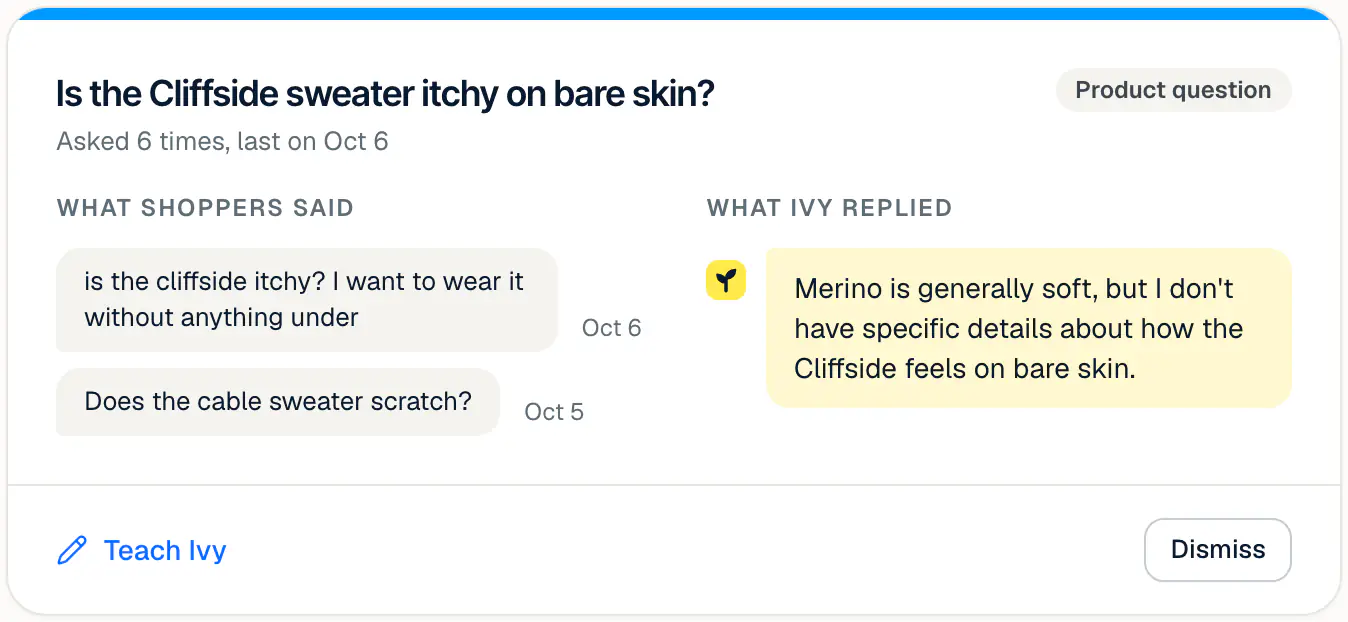
She answers only from your store, and says when she doesn't know. No invented products, prices or discount codes. A question she can't answer lands on the Unanswered list, grouped with the others like it, and you answer it once with Teach Ivy.
The team side is built in. Handoff rules and keyword rules, Ivy's summary and drafted reply, a shared inbox with Needs you, business hours, a reply target and the iPhone app for your team, free on the App Store, on every plan.
Where a helpdesk still wins: if your team works large volumes of email, social or phone tickets, Strathly doesn't answer those channels. Many stores keep a helpdesk for email and move the storefront chat to Strathly, where most of their questions and all of their chat sales happen.
How Strathly helps
If you opened this comparison because support costs keep rising with your volume, the useful question is not which helpdesk meters you more fairly, but how many conversations need a person at all. Strathly answers that in the storefront chat, before a ticket exists.
Ivy knows your store. She reads your Shopify catalog, policies, pages and shipping rates, plus the files, web pages and answers you add, and keeps them in sync. How Ivy learns your store explains each source, and the docs show how unanswered questions are grouped for you.
She resolves orders within your rules. Status and tracking in the chat; refunds, cancellations, address changes and replacements prepared for approval or done by her when you allow it, with a cap, shopper verification and Undo.
She sells. Recommendations with product cards, Add to cart and a Shopify cart with checkout, in the shopper's language.
She hands off well. Your rules decide what reaches a person; your teammate gets the summary, the reason, the order and a reply ready to send, on the web or on the phone.
Your price stays readable. One unit, the Ivy conversation; your team unlimited; every feature on every plan; extras that never expire; no automatic overage. The setup is the Shopify app and its theme app embed, and what Strathly reads from Shopify lists every permission and why. For the full picture, see everything Ivy and your team get.
Switching from Gorgias or Zendesk to Strathly
You can move only the storefront chat and keep your helpdesk for email, or move everything that happens in the chat in one afternoon.
- Set Ivy up while your current chat stays on. Connect Shopify, let Ivy read the store, set her name and tone, and test her in the Playground. Nothing shows on your store until you go live.
- Bring over what your helpdesk knew. Gorgias macros and Zendesk help center articles become Ivy's knowledge through Teach Ivy, a file (PDF, DOCX, TXT, MD or CSV) or a web page Ivy reads. Past tickets don't move: keep them in your helpdesk.
- Recreate your routing as handoff rules. Refunds, upset shoppers, wholesale orders and your own keywords become rules, each with an action. Set your business hours and reply target.
- Swap the chats in one theme save. Switch on Strathly's app embed and switch off the old chat widget together, so shoppers never see two chat buttons. The docs walk through it in move from another chat app.
- Invite your team. Teammates answer from the web Inbox and the iPhone app.
Frequently asked questions
Is Gorgias better than Zendesk for Shopify?
Yes, for most Shopify stores. Gorgias was built for ecommerce: agents refund, cancel and edit Shopify orders inside the ticket, its AI Agent knows commerce, and the team isn't priced per seat. Zendesk is better for large, multi-department support that goes beyond a store, with voice, a help center and workforce tools.
Is Gorgias cheaper than Zendesk?
Usually, for a small store. Gorgias prices by tickets with agents included, while Zendesk prices every agent seat; with two agents and 300 conversations a month, our worked example came to about $270 at Gorgias and about $418 at Zendesk on monthly billing, AI included. For a large team with few tickets per agent, the math can flip.
Does Zendesk integrate with Shopify?
Yes. Zendesk's Shopify integration shows a customer's orders in the ticket sidebar, where agents can refund an order or cancel one that hasn't shipped. Editing orders or letting the AI agents act on them means building flows with Zendesk's integration tools. Its Shopify App Store listing holds 3.2 stars from 95 reviews, 31% of them one-star.
Can the Gorgias and Zendesk AI agents refund or cancel orders?
Gorgias's can, once you switch Actions on (Basic and above): it cancels unfulfilled orders with a refund, edits the shipping address, removes or replaces items and reships for free. For Zendesk's AI agents we found no official page showing Shopify order actions; its agents refund and cancel from the sidebar. Strathly's Ivy prepares refunds, cancellations, address changes and replacements for one-click approval, or does them herself for the actions you switch on, within a money cap and for a verified shopper.
Is Gorgias or Zendesk better than Strathly?
No: for a Shopify store whose customers write in the storefront chat, Strathly does more for less, because Ivy sells and works on orders in the chat, one conversation is one unit whether she resolves it or hands it off, and your team's replies never count. The honest exception: if your team works large volumes of email, social or phone tickets, a helpdesk is built for that and Strathly isn't.
Can I use Strathly together with Gorgias or Zendesk?
Yes. Many stores move only the storefront chat to Strathly and keep their helpdesk for email and social tickets. Ivy answers, sells and resolves in the chat, so fewer questions become tickets; turn off the helpdesk's chat widget in the same theme save, so shoppers see one chat.
Which one has the better AI for ecommerce?
Gorgias's AI Agent, between the two: it combines post-purchase support with a shopping assistant and starts with Shopify built in, while Zendesk's AI agents are general-purpose and need more configuration for commerce. Both bill per resolved interaction. Strathly's Ivy is built only for Shopify stores and adds product cards, Add to cart and a cart with checkout in the chat.
Conclusion
Between the two helpdesks, the verdict is clear: Gorgias is the better choice for a Shopify store, and Zendesk is the better choice for a company whose support is much bigger than its store. Gorgias knows Shopify orders and doesn't charge per seat; Zendesk brings the broadest suite and charges for every agent. Both bill their AI per resolution, so the AI costs more the better it works.
If your customers mostly write in your storefront chat, you don't need to pick a meter. Strathly resolves and sells in the chat before a ticket exists, works on orders within your limits, hands the rest to your team with the reply already drafted, and counts only Ivy's conversations, with your team unlimited on every plan.