Blog · Comparisons
Intercom (Fin) alternatives for ecommerce: 7 options after the Salesforce deal [2026]
The best Intercom alternatives for an online store sell in the chat, work on orders and bill a unit you can predict. Salesforce completed its purchase of Fin, formerly Intercom, on September 10, 2026; here are seven options for ecommerce, with prices read on October 17, 2026. For Shopify stores, Strathly comes first.
Updated · The Strathly team · 27 min read
On this page
- What changed at Intercom and Fin in 2026
- Why online stores look for an Intercom alternative
- The 7 Intercom alternatives at a glance
- 1. Strathly: the best Intercom alternative for Shopify stores
- 2. Gorgias: best for large teams that need a full ecommerce helpdesk
- 3. Zendesk: best for companies with support beyond the store
- 4. Tidio: best free start on any platform
- 5. Zipchat: best for AI sales across the site, WhatsApp and Instagram
- 6. Richpanel: best for DTC brands that want self-service and AI order actions
- 7. Help Scout: best for small teams whose support is mostly email
- How to choose an Intercom alternative for your store
- Switching from Intercom to Strathly
- How Strathly helps
- Frequently asked questions
- Conclusion
Intercom alternatives are on many store owners' lists this autumn, and not only because of the price. Intercom renamed itself Fin in May 2026, Salesforce completed its acquisition of Fin on September 10, 2026, and the bill still has two parts: a seat for every teammate in the helpdesk and $0.99 for every outcome its AI agent reaches. If your support budget is a line you have to defend each month, a bill you can't forecast and an owner you didn't choose are both fair reasons to look around.
This guide is written for online stores, not for software companies. Most "Intercom alternatives" lists compare tools for SaaS onboarding and product tours; here every option is judged on what a store needs from its chat: an AI shopping assistant that recommends from your live catalog, order status and order changes, a clean handoff to your team, and a unit of billing you can predict. Every price and feature was read from official pages and Shopify App Store listings on October 17, 2026.
One thing up front: Strathly is built only for Shopify stores, and so is Fin for Ecommerce, Intercom's own version for stores. If you sell on Shopify and want to see the difference on your own catalog: Install on Shopify. Setup takes about 2 minutes. 14-day free trial. Cancel anytime. The docs show how to move from another chat app without a day of two chat buttons.
What changed at Intercom and Fin in 2026
Three things changed this year, and one did not. Intercom renamed the company after its AI agent in May 2026 (the helpdesk keeps the Intercom name), Salesforce signed an agreement to buy Fin on June 15 and completed it on September 10, and Fin launched a version built for Shopify stores. The pricing model is the same as before the deal.
What Salesforce's press release of September 10, 2026 says: Fin, "formerly Intercom", becomes part of Salesforce's AI Labs, it "will continue to serve its customers", and it brings a customer base of more than 30,000 companies. The completion release did not disclose financial terms; the deal was reported at about $3.6 billion when it was announced in June. Fin's website now carries the line "from Salesforce" under its logo.

Fin for Ecommerce is the closest thing Intercom has to a store assistant. Its page describes product questions while shoppers browse, recommendations from Shopify variants, prices and availability, guidance to checkout, and tracking, returns, exchanges and order updates in the same conversation, in 45 languages. Its FAQ is clear on two limits: it "is only available to Shopify-powered businesses", and it "requires Intercom and is not available as a standalone product". Intercom's help center adds that Fin for Ecommerce beyond Shopify is in a closed beta.
What the acquisition means for a store today: nothing you can measure yet. Prices, plans and the product are unchanged, and the release promises continuity. What it means for your next contract is the open question, and that uncertainty is why "Fin alternatives after the Salesforce acquisition" pages appeared within weeks of the announcement.
Why online stores look for an Intercom alternative
Stores leave Intercom for four documented reasons: two meters on one bill, an AI fee tied to outcomes that are hard to forecast, a helpdesk built for software companies first, and the change of ownership. None of them means Fin is a weak agent; it is a strong one. They mean it may not be the right shape for a store.
Two meters. Every teammate in the Intercom helpdesk is a paid seat, with at least one full seat to start, and every Fin outcome is $0.99 on top. A store that adds a seasonal helper for November pays for the seat, and a busy month raises the outcome line at the same time.
Outcomes you can't count in advance. Per Fin's pricing page, an outcome is charged when "a customer confirms their issue is resolved", when "they don't ask for more help after Fin responds", or when Fin completes a workflow (a Procedure), including one that ends in a handoff to your team. It is charged once per conversation at most. A shopper who leaves after the answer counts the same as one who says thank you, so the bill follows behavior you don't control.
Built for software first. Intercom's own plans sell product tours, in-app messages and outbound campaigns as add-ons; a store pays for a platform designed around logged-in app users. On Shopify, the Fin AI Agent and Intercom listing is rated 3.7 from 18 reviews, with 22% of them one-star (Shopify App Store, read October 17, 2026).
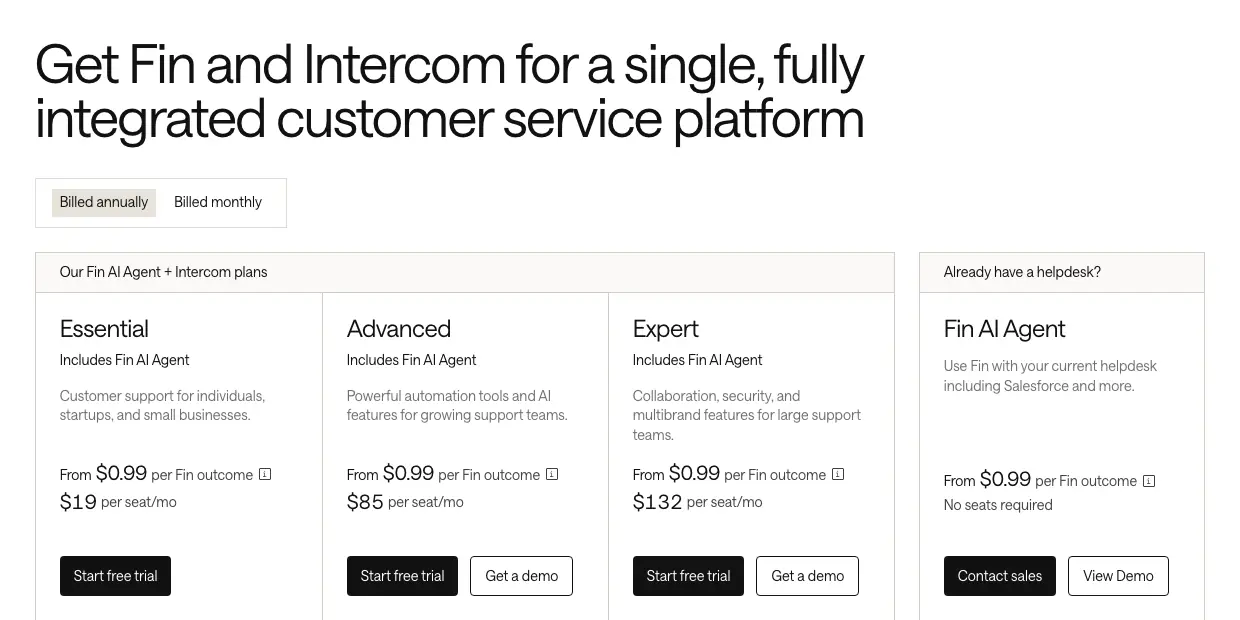
Intercom and Fin pricing (Intercom's pricing page and fin.ai/pricing, read October 17, 2026):
- Essential: $29 per seat a month billed annually, $39 billed monthly. The page is running a price test: some visitors see $19 billed annually, as in the screenshot above.
- Advanced: $85 per seat billed annually, $99 monthly. Expert: $132 billed annually, $139 monthly.
- Fin AI Agent: $0.99 per outcome on every plan, at most one per conversation; qualifications for sales are $9.99 each.
- Fin on another helpdesk (Zendesk, Salesforce, HubSpot and others): $0.99 per outcome with no seats, and a minimum of 50 outcomes a month.
- Copilot for agents: $29 per agent a month billed annually, $35 monthly. Voice is on custom pricing; SMS and phone are usage-based.
- A 14-day free trial with no card and unlimited outcomes during the trial.
For the full comparison of Fin with eight other AI chatbots on selling, orders and billing, see how Fin compares with other AI chatbots for ecommerce.
The 7 Intercom alternatives at a glance
| Tool | Best for | You pay per | Shopify depth |
|---|---|---|---|
| Strathly | Shopify stores that want one agent for sales and support | Ivy conversation (team conversations unlimited) | Built only for Shopify: catalog, policies, shipping, orders and order actions |
| Gorgias | Large teams that need a full ecommerce helpdesk | Helpdesk ticket, plus AI automated interaction | Deep: orders in every ticket, AI order actions |
| Zendesk | Companies with support beyond the store and many channels | Agent seat, plus automated resolution | An integration app: agents refund and cancel from the sidebar |
| Tidio | A free start and one inbox for chat, email and social | Helpdesk conversation, plus Lyro conversation | An app for Shopify and other platforms; Lyro acts on orders |
| Zipchat | AI sales across the site, WhatsApp and Instagram | AI reply | Apps for Shopify and six other platforms; order actions |
| Richpanel | DTC brands that want a helpdesk with self-service and AI order actions | Agent seat, plus AI conversation | Deep: order edits, returns, subscriptions |
| Help Scout | Small teams whose support is mostly email | User seat, plus AI resolution | An integration: agents see and edit orders; no AI order actions listed |
Prices are in each entry with their source. Strathly is the only option here that bills one unit, the conversations its AI takes, with no seat fee for the teammates its plan includes and no per-resolution fee.
1. Strathly: the best Intercom alternative for Shopify stores
Only the conversations Ivy takes count: your team's conversations are unlimited on every plan, and every feature is on every plan. That is the opposite of Intercom's bill. There is no per-outcome fee to forecast, no seat to buy for each teammate your plan includes, and no add-on that unlocks the useful part. The plans differ only in how many conversations Ivy handles and how many teammates join.
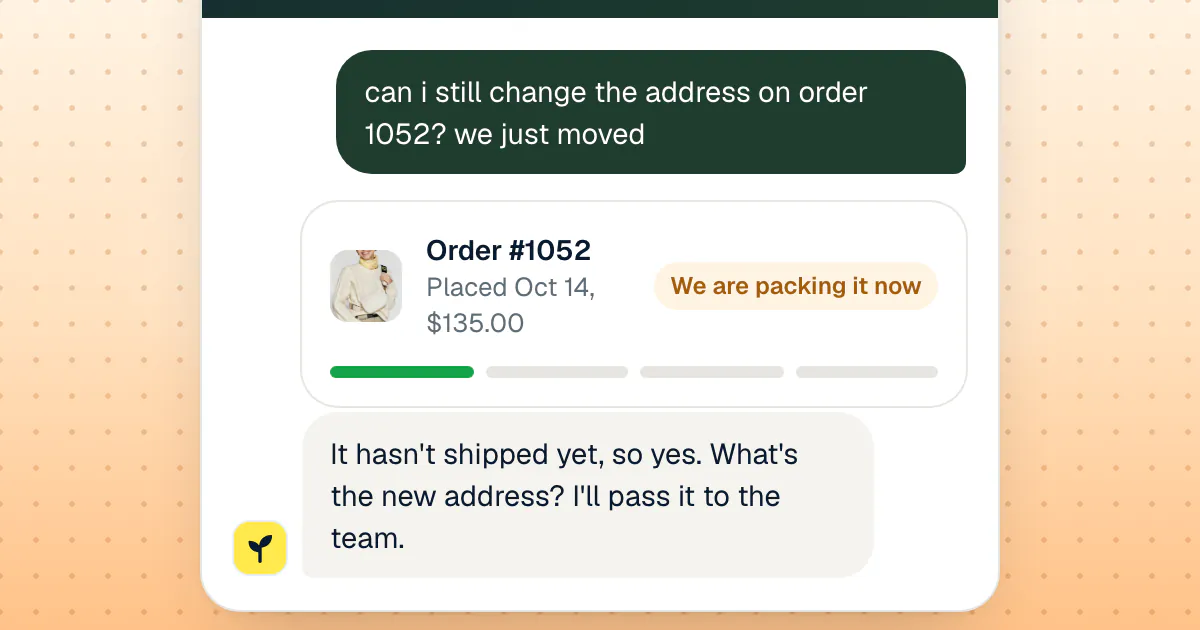
And Ivy doesn't stop at answering: she works on the order. With an order number and the email used at checkout, she shows the shopper the status, the carrier and the tracking link from Shopify. Refunds, cancellations, address changes and free replacements are prepared as drafts your team approves with one click, or, when you switch an action on, done by Ivy herself within the money cap you set, only for a shopper who proved the order is theirs, with 10 seconds to undo before anything reaches Shopify.
Runs on: Shopify only. Ivy is Strathly's assistant; she lives in a chat widget that goes into your theme as a Shopify app embed, with no code and no Intercom-style Messenger snippet to maintain.
Selling in the chat
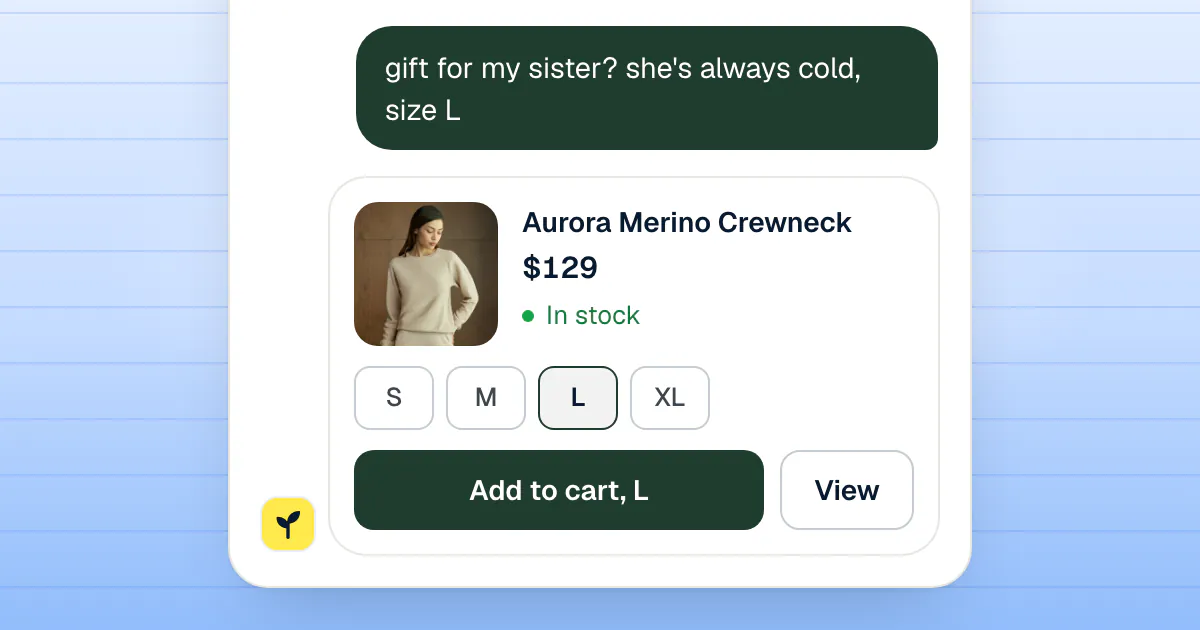
Fin for Ecommerce made selling in the chat part of the Intercom pitch; with Strathly it is the default on every plan. Ivy reads your products, variants, prices, stock and options from Shopify, along with your policies, published pages and shipping rates. When a shopper describes what they want, she answers in their words and shows a card for each product she recommends: photo, price, stock, an option picker and Add to cart. When they are ready, she builds a real Shopify cart with a Checkout button.
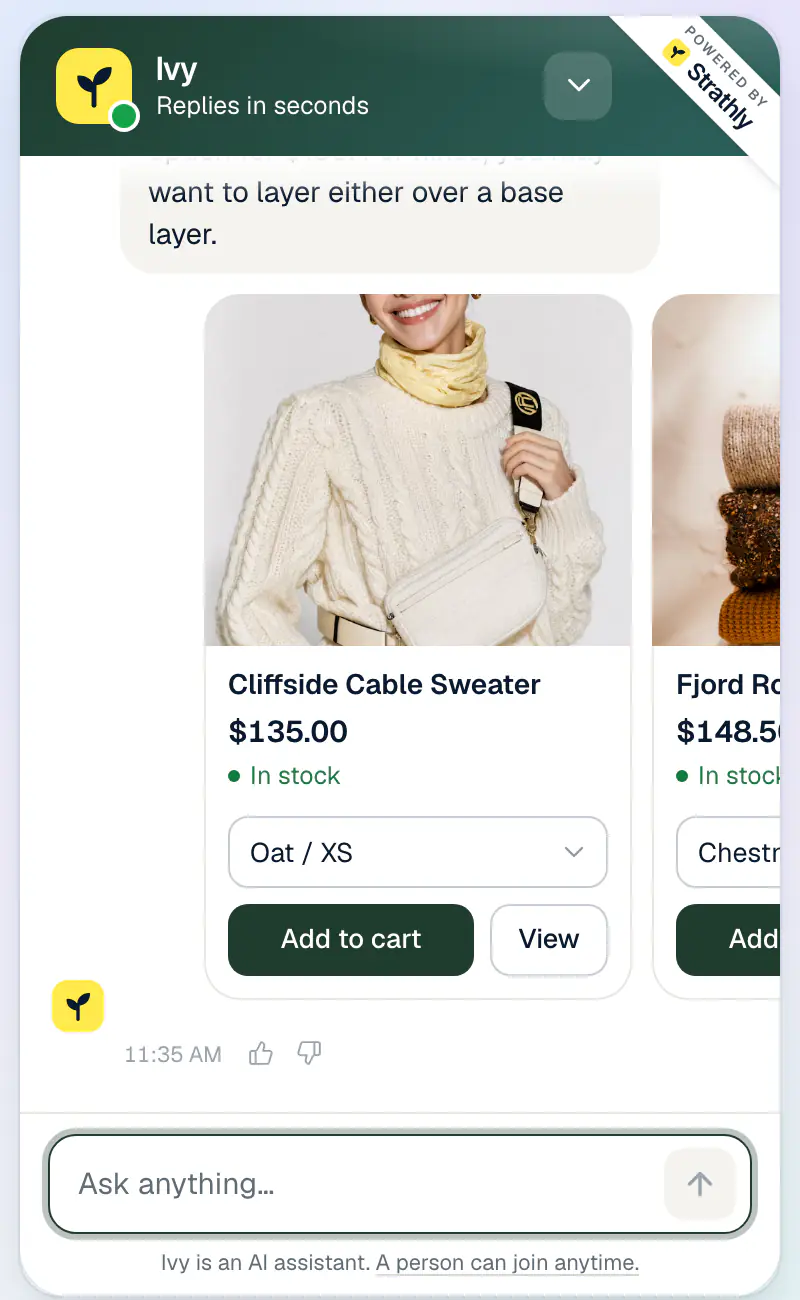
You decide what she may suggest. Every product has an "Ivy can recommend it" switch, and a private note per product ("runs small, suggest a size up") steers her without touching your Shopify description. The docs explain how Ivy picks products and builds carts.
Answers from your store, and you can see why
The fear behind every AI chat is the invented answer. Ivy answers only from your catalog, policies, pages, files and the answers you teach her; she never invents a product, a price or a discount code. When nothing in your store answers a question, she says so, hands off, and the question lands on your Unanswered list so you can teach her once.
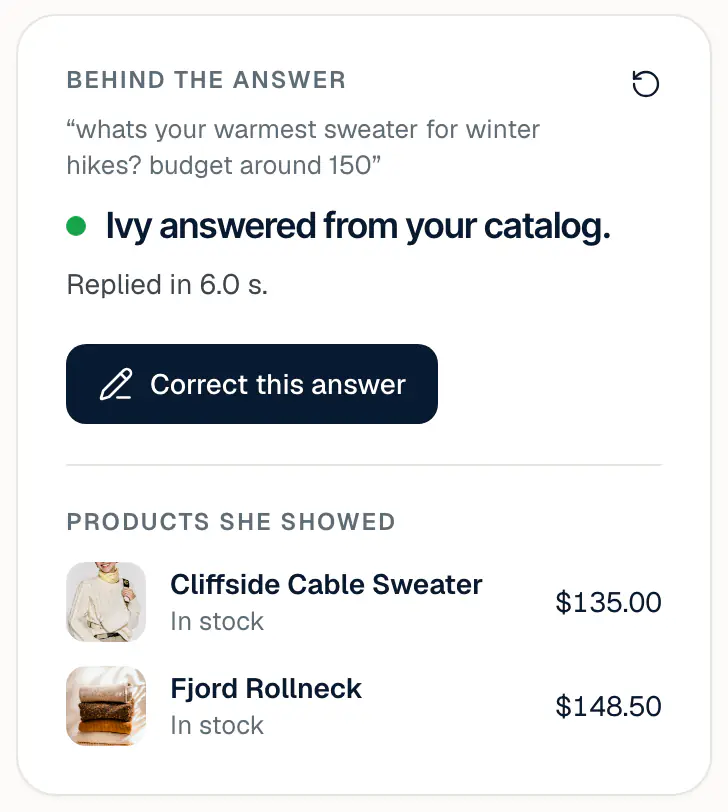
Your team sees what each answer was based on. In the Playground, where you test Ivy on your real data before and after going live, every reply comes with "Behind the answer": what she answered from, the products she showed, and a Correct this answer button.
Orders, handoff and your team
Order status needs no setup, and order changes are cautious on purpose. By default Ivy prepares the change and a teammate presses one button such as Send and refund; you let her act alone one action at a time, with a cap per order. Order status and order changes in the chat lists what she can do and when; exchanges and partial cancellations always go to a person.
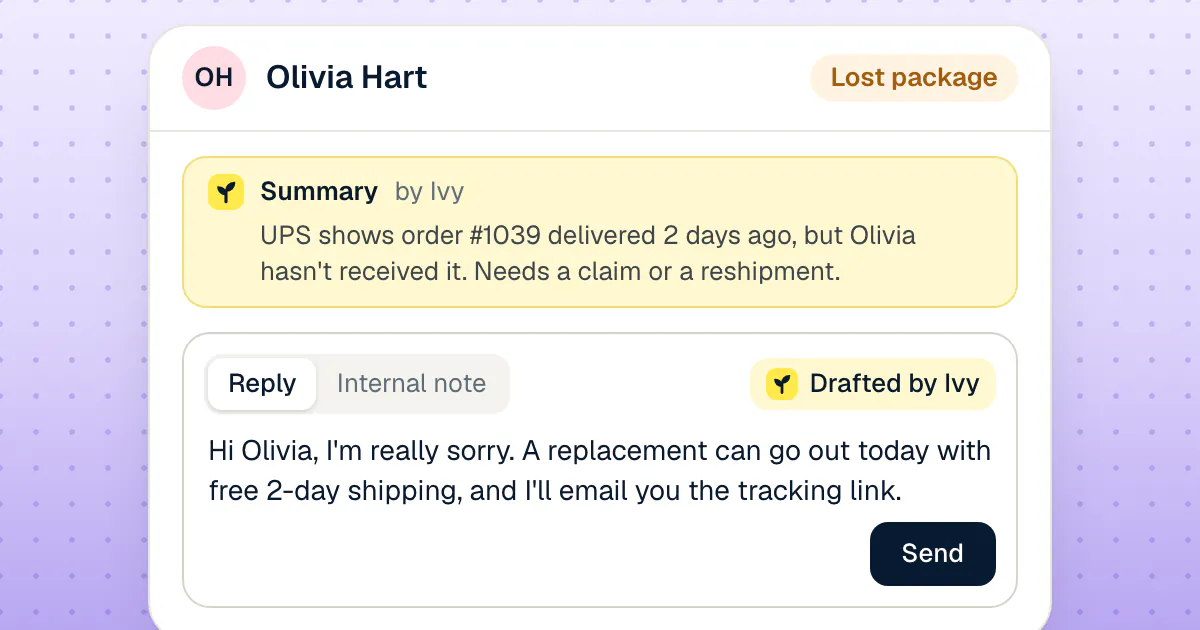
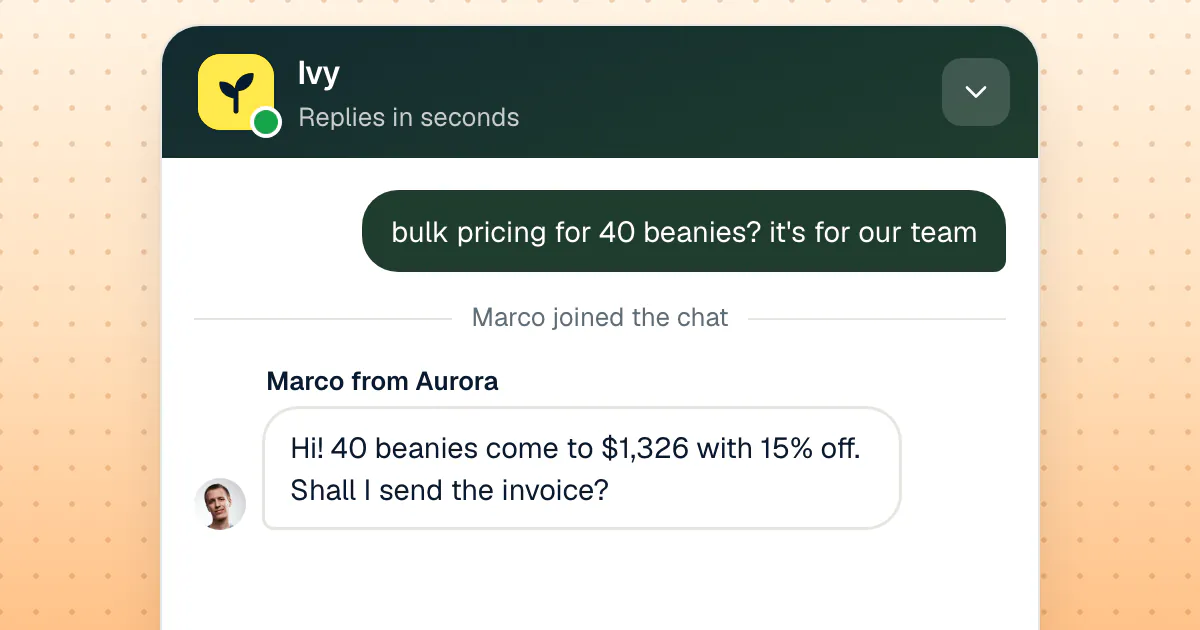
Handoff rules decide what reaches your team: a refund request above an amount you choose, a shopper who asks for a person or sounds upset, a wholesale order, or words you list such as "chargeback". Each handoff arrives in the shared inbox with Ivy's summary and a drafted reply to edit or send. Where the line between the AI and your team should fall is its own decision; our guide to chatbot vs live chat for online stores draws it question by question. A handoff costs nothing extra, and when the shopper has left, they get your team's reply by email.
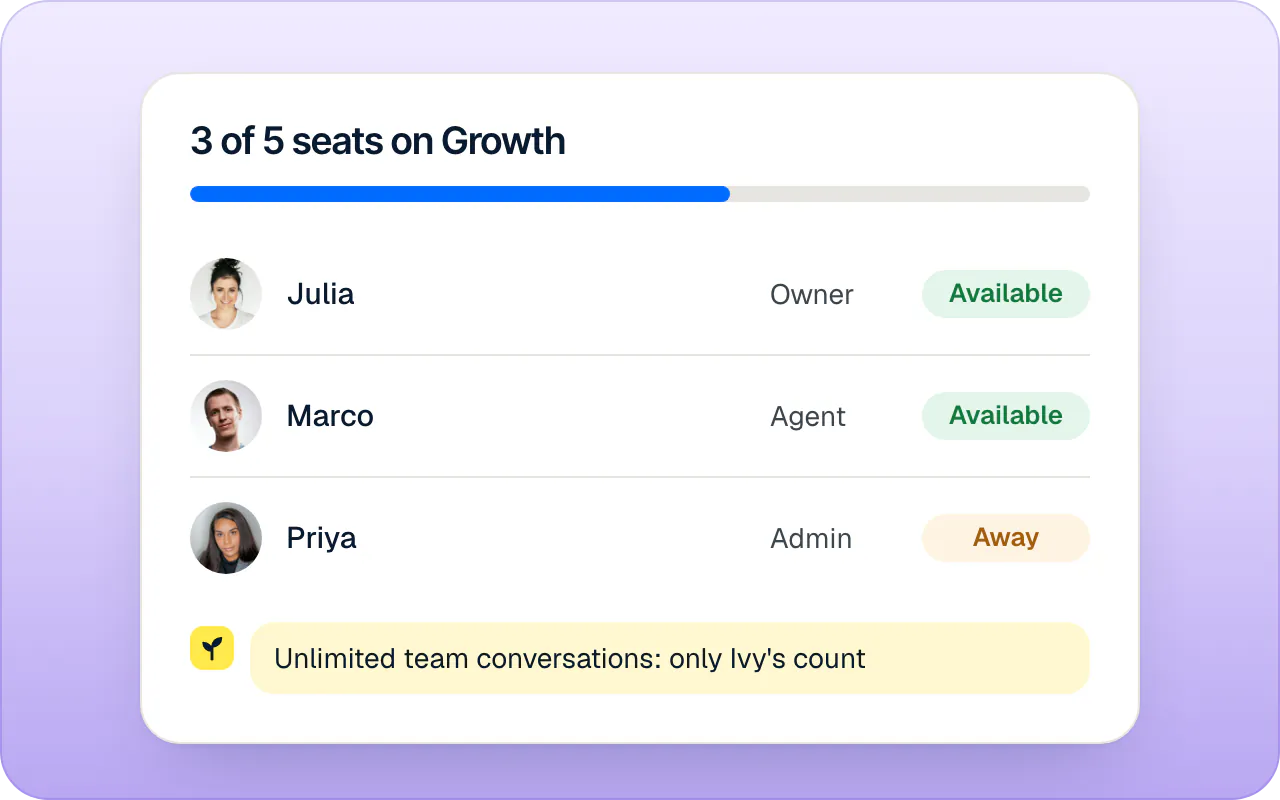
Your team answers from the web dashboard or from the iPhone app with a push when a shopper needs you, included in every plan and free on the App Store. Business hours decide what Ivy does while you're away: keep answering and take the shopper's email, or hand off anyway.
Strathly pricing
| Plan | Price a month | Ivy conversations a month | Extra conversation | Teammates |
|---|---|---|---|---|
| Starter | $39 | 100 | $0.39 | 2 |
| Growth | $79 | 300 | $0.26 | 5 |
| Scale | $199 | 1,000 | $0.20 | Unlimited |
Prices in US dollars, excluding VAT and sales tax. Everything one shopper asks Ivy within 24 hours is one conversation, with one more every 30 of her replies in a very long chat. A conversation she resolves and one she hands off cost the same: one. Spam and conversations stopped by the chat's protections never count. Extra conversations are bought ahead from 10 at a time at your plan's rate and never expire, and there is no automatic overage. The rule in full: what counts as a conversation.
Pros
- One unit, the Ivy conversation; your team's conversations unlimited and no per-seat fee for the teammates your plan includes.
- Sales and support in one agent on every plan: product cards, Add to cart, a real cart, order status and order changes.
- Order actions with approval by default, shopper verification, a money cap and 10 seconds to undo.
- Handoff rules, Ivy's summary and drafted reply, business hours and the iPhone app, with no add-ons.
Cons
- There is no free plan. What you get instead is a 14-day free trial on Growth with every feature from day one, order actions, analytics and the iPhone app included, and your team's conversations unlimited, where free tiers elsewhere stop at answering questions.
2. Gorgias: best for large teams that need a full ecommerce helpdesk
Gorgias is the ecommerce helpdesk most Intercom switchers look at first: one inbox for email, chat, social, SMS and voice, built around Shopify orders, with an AI Agent that resolves support questions and works as a shopping assistant. If your team lives in tickets across many channels, it is the closest like-for-like replacement for Intercom's helpdesk.
Runs on: Shopify, WooCommerce, BigCommerce, Magento and PrestaShop.
What it does for a store: agents see Shopify orders in every ticket and can refund or edit them; the AI Agent tracks orders, cancels them, processes returns and updates addresses, and recommends products in its shopping-assistant role.
Pricing (Gorgias's pricing page with the AI Agent added, read October 17, 2026):
- Starter: $40 a month for 50 tickets and 30 automated interactions, monthly billing only.
- Basic: $90 a month ($77 billed annually) for 300 tickets and 30 automated interactions.
- Pro: $550 a month ($471 billed annually) for 2,000 tickets and 190 automated interactions; Advanced: $1,430 ($1,227) for 5,000 and 530.
- Above the allowance, an automated interaction costs $1.50, and the pricing page states that "each AI Agent interaction also counts as a helpdesk ticket".
- A 7-day free trial without payment details.
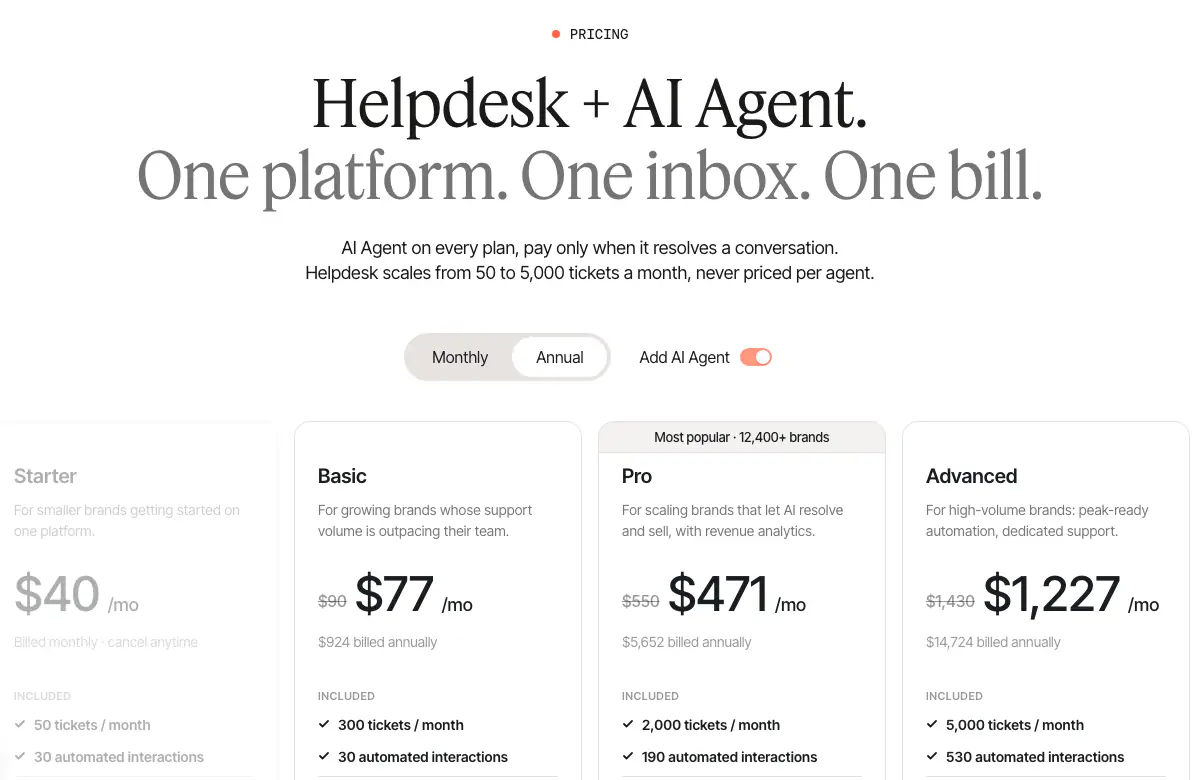
Pros: the deepest ecommerce helpdesk in this list, every channel including voice, a helpdesk "never priced per agent", mobile apps, 4.3 stars from 706 reviews on the Shopify App Store.
Cons: two meters for one AI-resolved conversation, and only 30 automated interactions on the two smaller plans. A store that mostly needs its storefront chat to sell and answer pays for a helpdesk it may not use; Strathly's Growth plan includes 300 Ivy conversations for $79, with no ticket fee. See also seven Gorgias alternatives for Shopify stores.
3. Zendesk: best for companies with support beyond the store
Zendesk is the general-purpose customer service suite that many Intercom customers already know: ticketing, messaging, voice and a help center, with AI agents and Copilot. It is not built for ecommerce, but it is the safe choice when your support also covers wholesale, B2B accounts or a product that isn't sold online.
Runs on: any business; Shopify through the Zendesk app, whose listing says agents can "process refunds and cancellations, directly from the Zendesk Support sidebar app".
What it does for a store: agents see orders next to the ticket; AI agents answer from your help center and run workflows such as order status and address updates; no ecommerce shopping assistant with product cards was found on its pages.
Pricing (Zendesk's pricing page, which showed euros to our European connection, read October 17, 2026):
- Support Team: €19 per agent a month billed annually, €25 monthly.
- Suite Team: €55 billed annually, €69 monthly, with 5 automated resolutions per agent a month; Suite Professional: €115 and €149, with 10.
- Extra automated resolutions: €1.50 each in committed volume packs, €2.00 pay as you go. Since May 18, 2026, Zendesk's help center counts only "verified resolutions" against the allowance; escalations don't.
- On the Shopify App Store: from $55 a month, with a free trial; a 14-day trial on the official page.
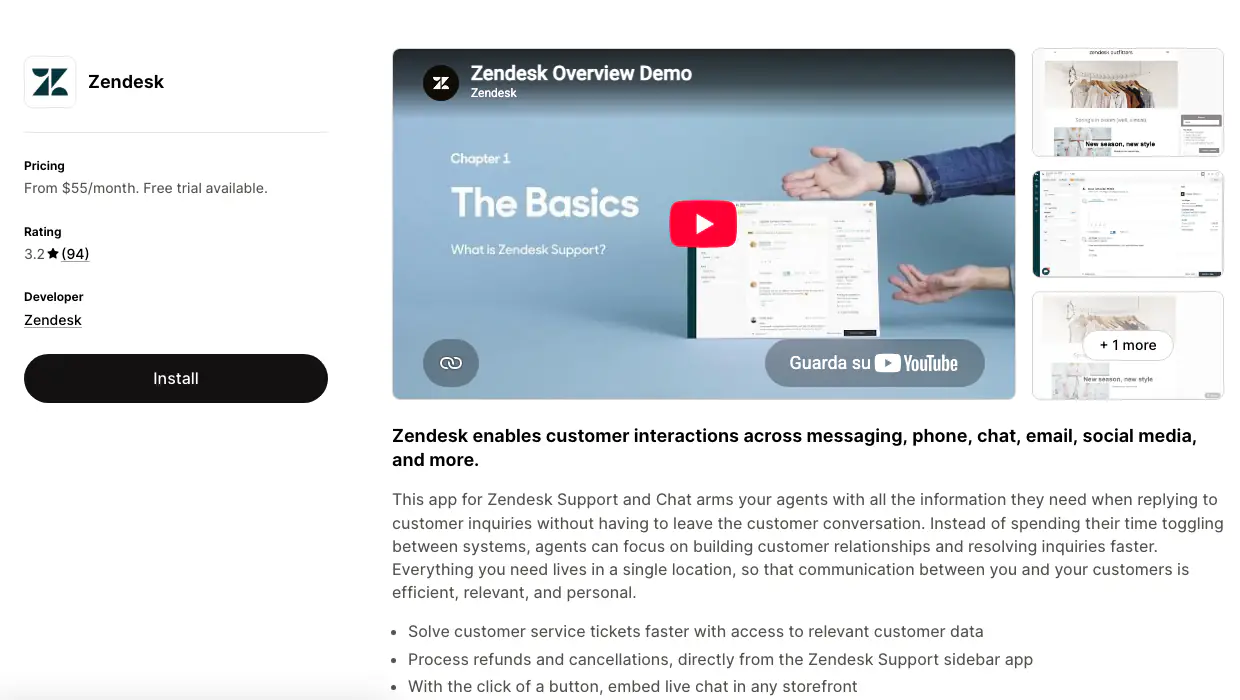
Pros: a mature suite with every channel, AI agents in many languages, only verified resolutions billed, mobile apps and a huge ecosystem.
Cons: seats plus a resolution meter, with a small allowance per agent; 3.2 stars from 94 reviews on the Shopify App Store; no shopping assistant. For three agents, Suite Team alone costs more a month than Strathly's Growth plan, which includes 5 teammates and 300 Ivy conversations. If Gorgias is your other option, see how Gorgias and Zendesk compare for a Shopify team.
4. Tidio: best free start on any platform
Tidio is a live chat and helpdesk for any website, with Lyro, its AI agent, sold as a separate meter. It is the cheapest way out of Intercom for a small store that wants a free plan and one inbox for chat, email, Instagram and WhatsApp.
Runs on: any website, with apps for Shopify, WooCommerce, Wix, BigCommerce, WordPress and others.
What it does for a store: per its Shopify App Store listing, Lyro handles "order status, refunds, cancellations and order edits", starts conversations on product pages, compares products and adds to cart; the team works from web and mobile apps.
Pricing (Tidio's pricing page plan data, monthly billing, read October 17, 2026; the page showed euros to our European connection):
- Free: 50 helpdesk conversations a month and 50 Lyro conversations once.
- Starter: $29 a month for 100 billable conversations; Growth from $59 for 250; up to 10 seats.
- Lyro AI Agent, on top: $39 a month for 50 Lyro conversations, $75 for 100, $140 for 200, $210 for 300, $700 for 1,000. Plus from $300 a month plus usage; Premium on request.
- A 7-day free trial with no card.
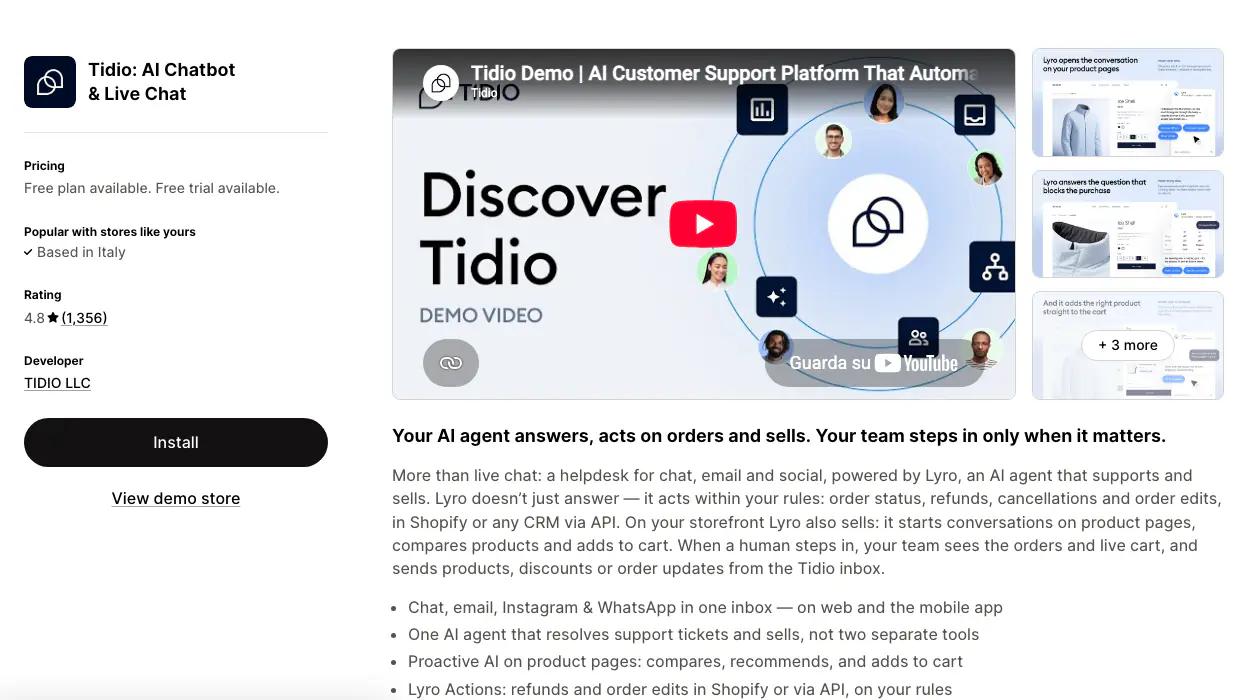
Pros: a real free plan, any platform, chat, email and social in one inbox, iOS and Android apps, 4.8 stars from 1,356 reviews on the Shopify App Store.
Cons: two meters again, helpdesk conversations and Lyro conversations, so AI at volume gets expensive: 1,000 Lyro conversations cost $700 a month before the helpdesk plan. Strathly's Scale plan covers 1,000 Ivy conversations for $199, team conversations included. More in Tidio alternatives for Shopify stores.
5. Zipchat: best for AI sales across the site, WhatsApp and Instagram
Zipchat is an AI sales and support agent for ecommerce brands that sells on several channels at once. Its homepage pitch, "One AI agent for the entire shopping journey", is close to Fin for Ecommerce's, without the helpdesk around it.
Runs on: Shopify and Shopify Plus, WooCommerce, BigCommerce, Magento and Adobe Commerce, Salesforce Commerce Cloud and PrestaShop.
What it does for a store: recommendations, add to cart, upsells and cart recovery; order tracking, returns and refunds pending your approval; handoff to its own live chat or to your helpdesk.
Pricing (Zipchat's pricing page, read October 17, 2026):
- Starter: $80 a month billed monthly, $64 billed annually, for 750 AI replies, which Zipchat estimates at about 300 conversations.
- Pro: $240 a month billed annually for 3,000 replies (about 1,250 conversations); Scale: $480 for 6,000; Scale Plus: $960 for 14,000; Unlimited from $2,100.
- Extra replies: $49 per 250 (per 500 on Scale Plus). Unlimited team members, a 7-day trial and a 30-day money-back guarantee; no free plan on its website.
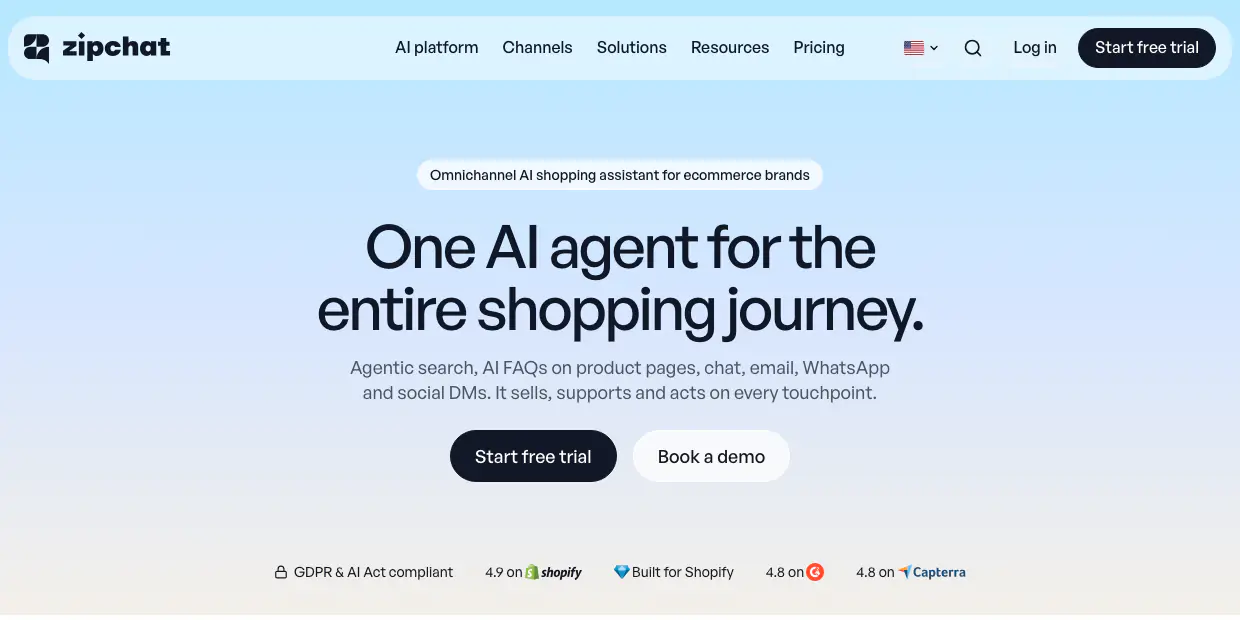
Pros: omnichannel AI on every plan, broad platform support, order actions with approval, unlimited seats, 4.9 stars from 208 reviews on the Shopify App Store.
Cons: every AI reply is a unit, so a long sales chat uses several, and the conversation figures are the vendor's estimates. Strathly counts a whole visit as one conversation, up to 30 of Ivy's replies. See Zipchat in our comparison.
6. Richpanel: best for DTC brands that want self-service and AI order actions
Richpanel is an ecommerce helpdesk built around AI agents that act on orders and a self-service portal where customers track, change and return orders themselves. It targets mid-size and large DTC brands, often switching from Gorgias or Zendesk, and its own content has been courting Fin customers since the Salesforce announcement.
Runs on: Shopify, its main integration, with an app on the Shopify App Store.
What it does for a store: order and shipping lookups, address edits, cancellations, returns, exchanges, refunds, store credit and subscription changes, with per-action permissions and optional human approval; email, chat, SMS, WhatsApp and social in one inbox.
Pricing (Richpanel's pricing page, read October 17, 2026):
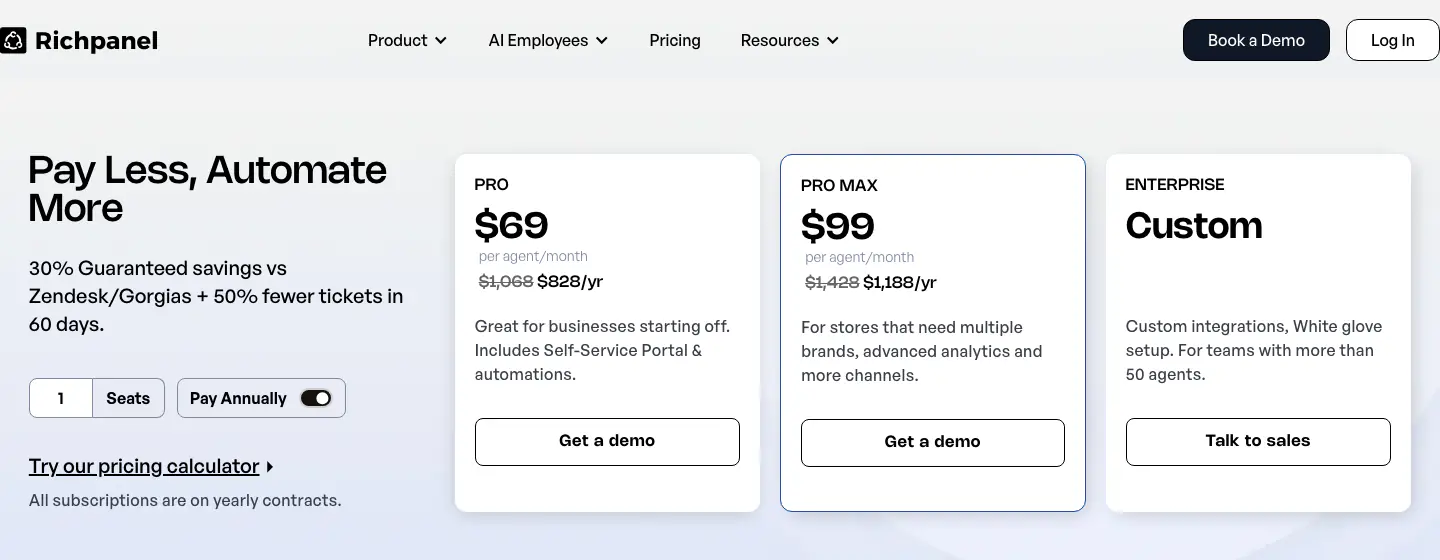
- PRO: $69 per agent a month ($828 a year); PRO MAX: $99 per agent a month ($1,188 a year); Enterprise: custom. "All subscriptions are on yearly contracts."
- Customer Service AI, on top: $0.20 per AI-handled conversation. Its drafting assistant and the self-service portal are free add-ons.
- On the Shopify App Store: PRO $89 a month and PRO MAX $119 a month, with a 14-day free trial; the website offers a demo instead.
Pros: the widest list of AI order actions here, a self-service portal, an automation guarantee, 4.9 stars from 137 reviews on the Shopify App Store.
Cons: yearly contracts on its website, seats plus AI usage, some self-service order flows marked "Coming Soon" on some plans, and no shopping assistant with product cards found on its pages. Strathly starts at $39 a month with no contract and sells in the chat on every plan.
7. Help Scout: best for small teams whose support is mostly email
Help Scout is a shared inbox and help center for small teams, with an AI agent (Scout in its docs, AI Answers on its pricing page) billed per resolution. It is the gentlest step down from Intercom when your store answers mostly by email and wants a simpler, cheaper inbox.
Runs on: any business; a Shopify integration shows orders in the sidebar so agents can see and edit them.
What it does for a store: its AI answers from your help center, website and text sources and routes complex conversations to your team; no AI order lookups or order actions are listed on its public pages, and no product recommendations.
Pricing (Help Scout's pricing page, billed annually, read October 17, 2026):
- Free: 5 users, 1 inbox and 100 contacts a month.
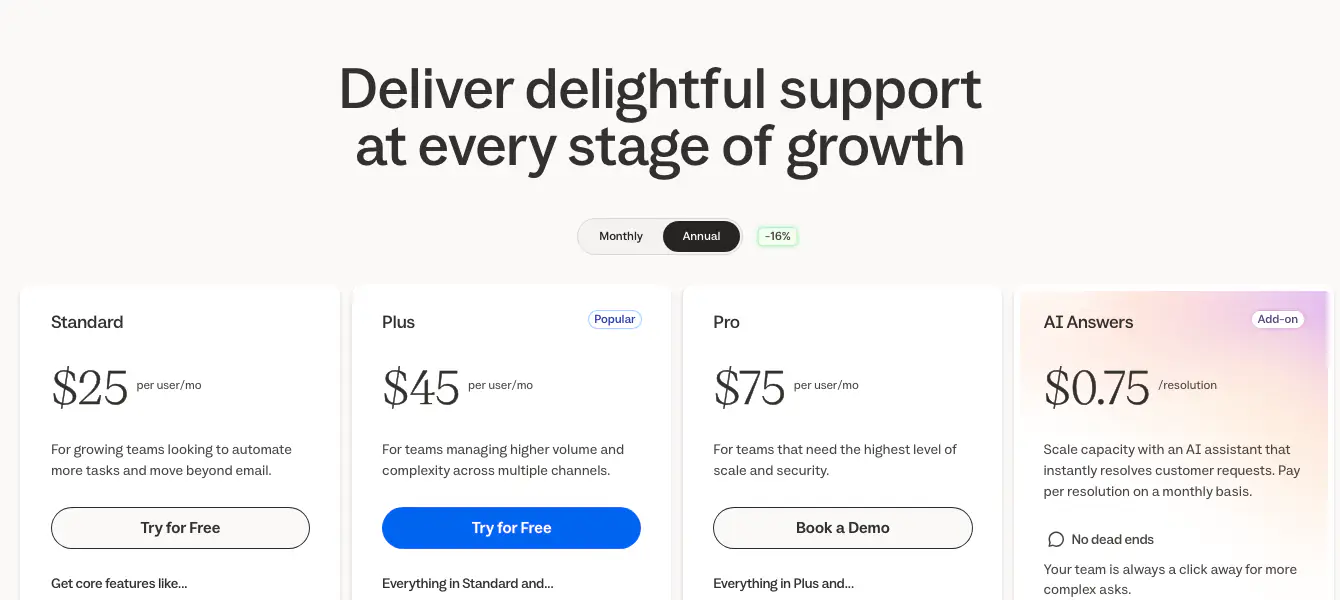
- Standard: $25 per user a month; Plus: $45; Pro: $75 (demo first). Annual billing saves 16% against monthly.
- AI Answers: $0.75 per resolution, one per conversation at most, not charged when the customer escalates; a monthly spending cap and three months of free unlimited resolutions for new accounts.
- A 15-day free trial with no card on Standard and Plus.
Pros: a free plan, a simple inbox, a spending cap on AI, 3.7 stars from 19 reviews on the Shopify App Store.
Cons: seats plus resolutions, and an AI that answers questions but lists no order lookups, order changes or product cards. For a store, that leaves the two jobs that matter most to a person; Ivy does both, on every Strathly plan.
How to choose an Intercom alternative for your store
Choose by your platform, then by what you want the AI to do on orders, then by the unit you will pay for. In that order, the list above narrows to one or two names in a few minutes.
Start with where you sell
If your store runs on Shopify, every option here is open to you, and a Shopify-only tool can go deeper: it reads your catalog, policies and shipping rates on install and works on orders through Shopify's own permissions. What Strathly reads from Shopify lists every permission and why. If you sell on WooCommerce, BigCommerce or a custom stack, your shortlist is Gorgias, Zendesk, Tidio, Zipchat and Help Scout.
Decide how far into orders the AI should go
Order status is table stakes. The difference is what happens next: does the AI tell the shopper to email you, or prepare the refund or the address change for your approval, and, if you choose, do it alone within a cap? Ask every vendor three questions: what happens by default, how the shopper proves the order is theirs, and how you undo a mistake. In Strathly, order actions wait for approval until you switch them on.
Compare the unit, not the headline price
Intercom bills seats and outcomes; Gorgias tickets and interactions; Zendesk seats and resolutions; Tidio conversations twice; Zipchat replies; Richpanel seats and AI conversations; Help Scout users and resolutions. A worked example makes the difference concrete. Take a store with 300 AI conversations a month and three people on its team, with the prices quoted above (October 17, 2026):
- Strathly: $79 on Growth, which includes 300 Ivy conversations and 5 teammates; resolved or handed off, each conversation is one.
- Intercom with Fin: 3 Essential seats at $29 billed annually ($87) plus up to 300 outcomes at $0.99 (up to $297): up to $384 a month, or $414 on monthly billing. Fewer outcomes lower the second line; you only know after the month.
- Tidio: $210 for 300 Lyro conversations plus a helpdesk plan for your team's conversations (Starter, $29 for 100): $239.
- Help Scout: 3 Standard users at $25 ($75) plus up to 300 resolutions at $0.75 (up to $225): up to $300, for an AI that answers questions but not orders.
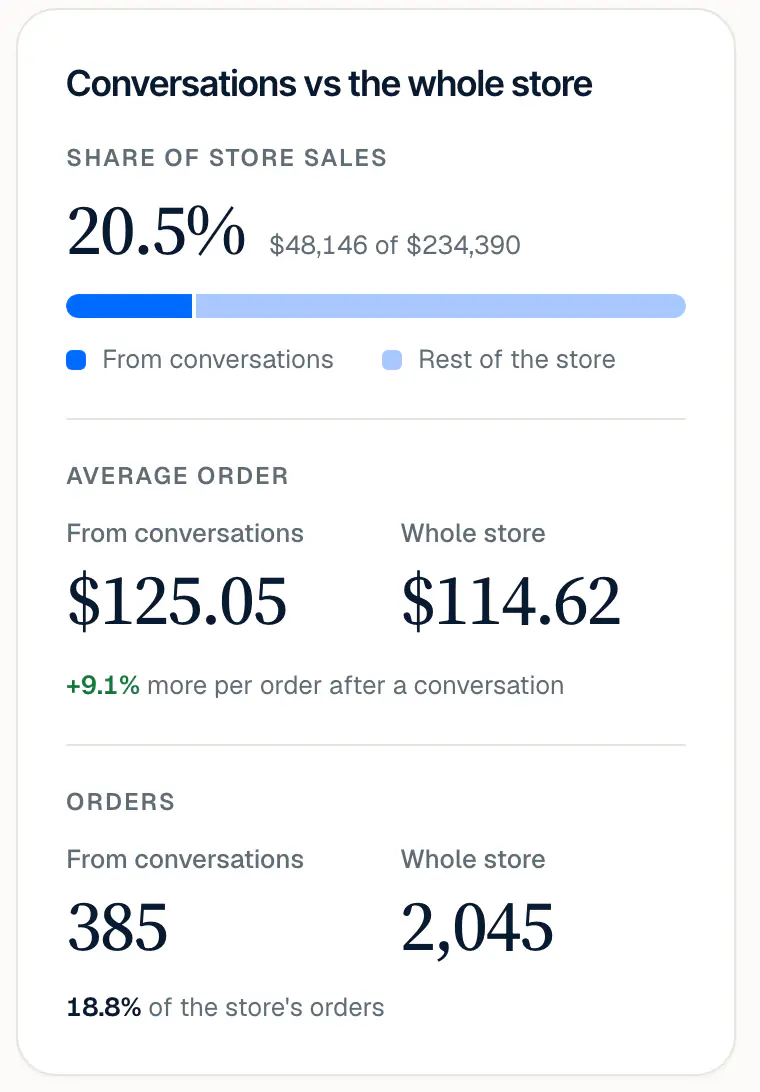
Price is half the sum; the other half is what the chat brings in. Strathly counts an order as a sale from a conversation when it is placed within 3 days of a chat with Ivy, and lists every one with the conversation that led to it. The docs explain the rule behind sales from conversations. Check whether any tool you trial can show you the same, order by order.
Run the same questions in every trial
Ask each tool's test mode the five questions your shoppers ask most: a sizing question, a gift request, "Where is my order?", an address change and a damaged item. Ten minutes per tool tells you more than any feature table, including this one. In Strathly that test is the Playground on your real catalog and orders. And start early: an agent chosen the week before a sale learns your store under pressure, which is why our Black Friday customer service checklist sets handoff rules and testing weeks ahead.
Switching from Intercom to Strathly
Switching takes one afternoon, mostly testing. There is nothing to export from Shopify, because Ivy reads your products, policies, pages and shipping rates herself; what you bring over is what only Intercom had.
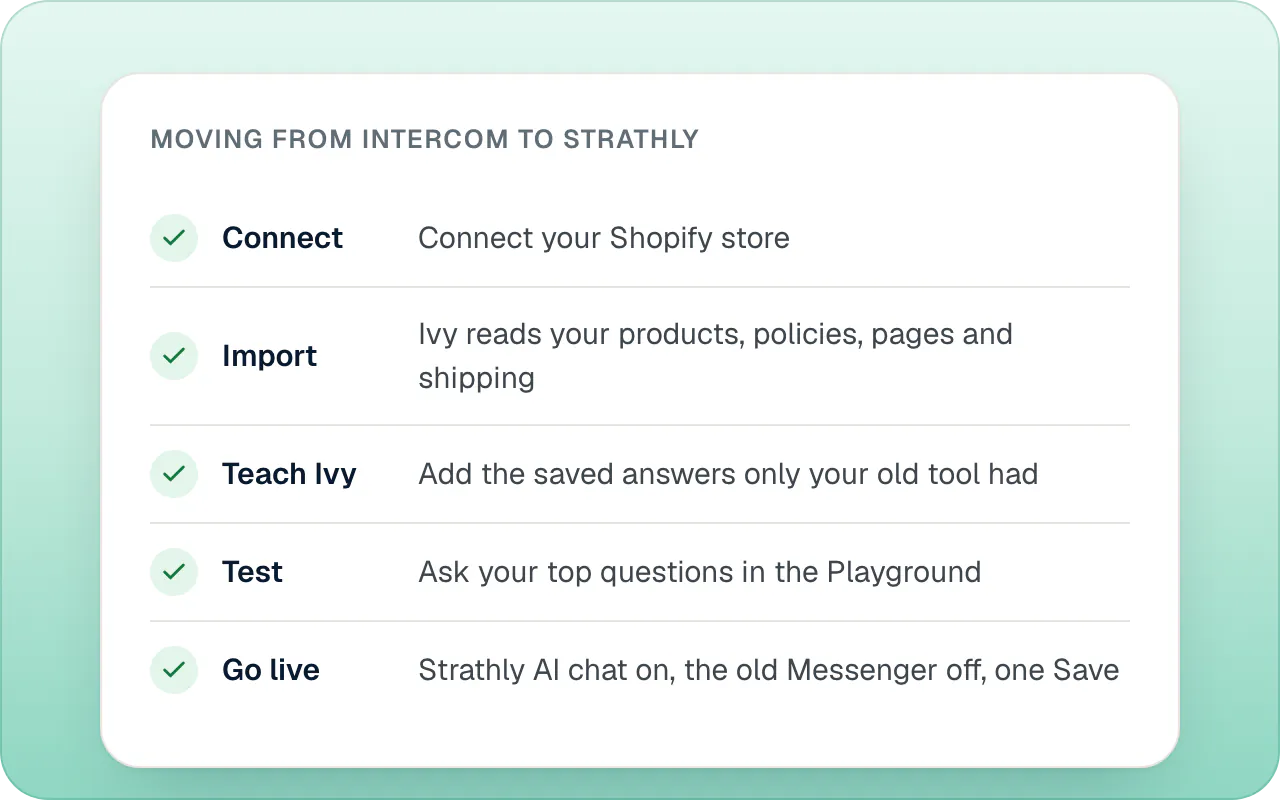
- Set Ivy up while Intercom stays on. Connect your Shopify store and let Ivy read it; nothing shows on your store until you press Go live. How Strathly goes from install to first answer shows the five steps.
- Bring over your saved answers. Add the answers your team wrote in Intercom with Teach Ivy, or upload them as a file in Knowledge. Past conversations don't move: keep Intercom's export if you need the history.
- Test in the Playground. Ask your top questions on your real catalog and orders, and correct any answer before a shopper sees it.
- Swap the chats in one save. In the theme editor's App embeds, switch on Strathly AI chat and switch off Intercom's Messenger, then press Save. If the Messenger isn't listed there, turn it off from Intercom's own settings or uninstall the Intercom app.
- Cancel Intercom with Intercom. Its billing is separate; check your contract's renewal date first.
The docs walk through each step in moving from another chat app, including what to do if two chat buttons show.
How Strathly helps
If your store runs on Shopify, Strathly does what Fin for Ecommerce promises, sales and support in one conversation, without the helpdesk seats underneath it or a per-outcome fee on top. Here is what you get, on every plan.
Answers grounded in your store. Ivy reads your products, policies, pages and shipping rates when you connect Shopify, and you add files, web pages and answers of your own. Each product shows exactly what she knows about it and whether she may recommend it. How Ivy learns your store explains the sources, and Teach Ivy fills a gap once for every shopper who asks.
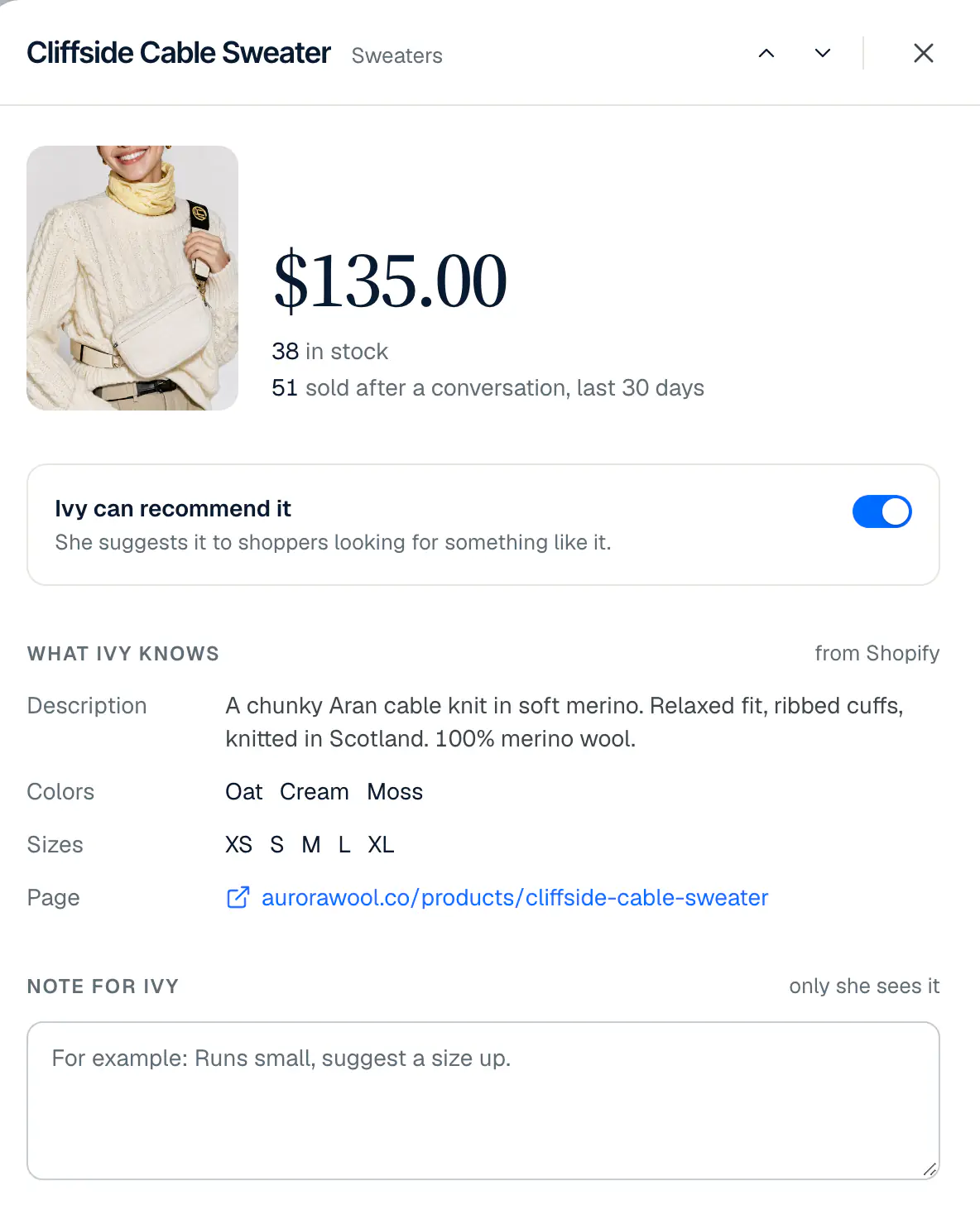
Sales you can check. Product cards with options and Add to cart, a real Shopify cart with checkout, and every order from a conversation listed with that conversation, in chat analytics you can check order by order.
Orders handled within your limits. Status and tracking from the order number and checkout email; refunds, cancellations, address changes and replacements prepared for approval, or done by Ivy within your cap when you switch them on, with shopper verification and Undo.
A team that isn't priced per head. Handoff rules and keyword rules, Ivy's summary and drafted reply, a shared inbox with Needs you, business hours and a reply target, and the iPhone app with push. The handoff to your team with a drafted reply shows the flow.
A setup measured in minutes. Connect Shopify, let Ivy read the store, test her in the Playground and switch on the app embed. Every feature, on every plan lists the rest.
A price you can plan. Only Ivy's conversations count, a handoff is not a separate charge, extra conversations never expire and there is no automatic overage. Work out your month with the pricing calculator.
Frequently asked questions
Did Salesforce buy Intercom?
Yes. Salesforce completed its acquisition of Fin, the company formerly called Intercom, on September 10, 2026, after announcing the deal on June 15. Fin joins Salesforce's AI Labs and, per the release, will continue to serve its customers. The Intercom name now refers to the helpdesk; Fin is the AI agent and the company.
What is the best Intercom alternative for a Shopify store?
Strathly: it sells with product cards and a real cart, answers and changes orders within your limits, hands off with a drafted reply, and bills only the conversations Ivy takes, with your team's unlimited. For a large team that needs email, social and voice tickets in one place, Gorgias is the strongest ecommerce helpdesk on this list.
Is Intercom better than Strathly?
No: for a Shopify store that wants its chat to sell and handle orders, Strathly does the same job for less, because one plan price covers the team and the AI instead of seats plus $0.99 per outcome. The honest exception: if you support customers across email, phone and in-app messages for more than a store, Intercom's helpdesk covers channels Strathly doesn't.
How much does Fin cost?
Fin costs $0.99 per outcome, at most once per conversation, on top of Intercom seats from $29 per seat a month billed annually ($39 monthly). Fin on another helpdesk needs no seats but has a minimum of 50 outcomes a month. Strathly bills a fixed monthly plan with conversations included; compare the plans.
Can I use Fin for Ecommerce without the Intercom helpdesk?
No. Fin's own FAQ says Fin for Ecommerce requires Intercom and is not sold as a standalone product, and it is available only to Shopify stores, with other platforms in a closed beta. Fin's general agent can run on Zendesk, Salesforce or HubSpot instead, with a monthly minimum.
Will my Intercom conversations move to Strathly?
No. Strathly has no importer for chat history, so keep an export from Intercom if you need it. Your products, policies and pages don't need importing at all: Ivy reads them from Shopify. Saved answers come over through Teach Ivy or a file in Knowledge.
Does Strathly work on WooCommerce or BigCommerce?
No, Strathly runs on Shopify only today. If your store is on another platform, Gorgias, Zendesk, Tidio, Zipchat and Help Scout in this list support it.
Conclusion
The Salesforce deal didn't change Fin overnight, but it is a good moment to ask whether a SaaS helpdesk with a per-outcome AI fee is the right shape for a store. Helpdesks win when your team lives in email, social and voice tickets; free chat apps win on the first invoice. For a Shopify store that wants one agent to sell, work on orders and hand off cleanly, Strathly does all of it on every plan, and your team's conversations never count. Ask Ivy your five hardest questions in the Playground and compare.